Israel has a GDP of $611B compared to $308M for the Marshall Islands, ranking 27/197 and 194/197 by economy size, respectively.
Israel has $418B in government debt (68.5% of GDP), compared to $36.3M (11.8% of GDP) in the Marshall Islands.
Israel vs Marshall Islands GDP by year
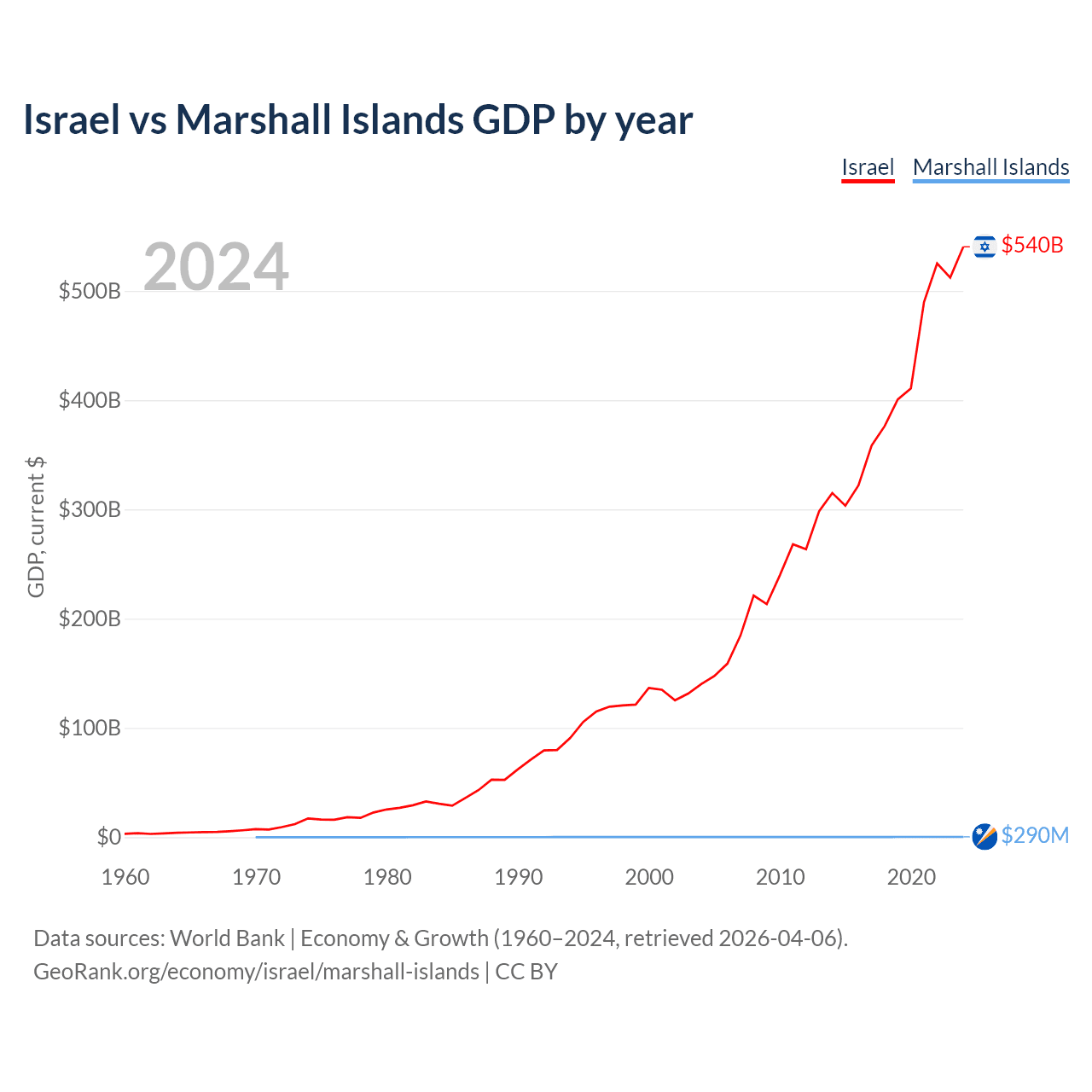
| Year | GDP, current $ | |
|---|---|---|
 Israel
|
 Marshall Islands
|
|
| 2025 | $610,777,842,874 | $308,000,000 |
| 2024 | $542,284,494,491 | $285,000,000 |
| 2023 | $513,393,395,492 | $264,000,000 |
| 2022 | $525,157,951,213 | $258,723,500 |
| 2021 | $489,735,019,666 | $261,245,500 |
| 2020 | $410,908,899,711 | $241,800,000 |
| 2019 | $399,207,771,082 | $232,900,000 |
| 2018 | $375,470,422,244 | $220,000,000 |
| 2017 | $357,360,816,857 | $213,700,000 |
| 2016 | $321,083,954,798 | $201,800,000 |
| 2015 | $302,841,190,258 | $183,700,000 |
| 2014 | $314,376,760,832 | $186,000,000 |
| 2013 | $298,045,324,736 | $186,400,000 |
| 2012 | $263,172,104,091 | $180,700,000 |
| 2011 | $267,739,352,609 | $172,300,000 |
| 2010 | $239,372,857,534 | $161,100,000 |
| 2009 | $213,112,649,594 | $151,200,000 |
| 2008 | $220,952,472,408 | $146,600,000 |
| 2007 | $184,448,882,452 | $150,500,000 |
| 2006 | $158,706,516,002 | $143,200,000 |
| 2005 | $147,346,035,831 | $138,000,000 |
| 2004 | $139,925,423,025 | $132,900,000 |
| 2003 | $131,278,887,815 | $131,128,500 |
| 2002 | $125,215,963,105 | $131,960,000 |
| 2001 | $134,889,159,474 | $122,406,100 |
| 2000 | $136,409,902,632 | $114,838,500 |
| 1999 | $121,329,240,042 | $113,352,100 |
| 1998 | $120,468,659,246 | $112,070,100 |
| 1997 | $119,389,303,067 | $109,884,700 |
| 1996 | $115,051,957,577 | $110,858,000 |
| 1995 | $105,432,315,611 | $120,230,000 |
| 1994 | $90,684,108,118 | $108,071,000 |
| 1993 | $79,806,598,120 | $99,461,000 |
| 1992 | $79,408,652,426 | $91,063,000 |
| 1991 | $70,954,941,681 | $82,507,000 |
| 1990 | $61,978,459,022 | $78,476,000 |
| 1989 | $52,411,116,588 | $72,798,000 |
| 1988 | $52,618,458,014 | $70,688,000 |
| 1987 | $43,022,977,765 | $62,983,000 |
| 1986 | $35,812,041,620 | $55,989,000 |
| 1985 | $28,887,898,639 | $43,879,000 |
| 1984 | $30,626,695,891 | $45,144,000 |
| 1983 | $32,655,591,256 | $41,749,000 |
| 1982 | $29,237,231,967 | $34,918,000 |
| 1981 | $26,865,420,933 | $31,020,000 |
| 1980 | $25,379,585,067 | $26,710,653 |
| 1979 | $22,595,788,591 | $25,545,346 |
| 1978 | $17,690,363,444 | $22,209,370 |
| 1977 | $18,245,847,441 | $20,210,069 |
| 1976 | $15,946,502,888 | $18,153,647 |
| 1975 | $16,131,806,290 | $16,691,301 |
| 1974 | $17,162,009,924 | $15,217,532 |
| 1973 | $11,895,229,181 | $11,607,366 |
| 1972 | $9,216,866,299 | $9,973,652 |
| 1971 | $7,048,191,876 | $9,116,810 |
| 1970 | $7,402,142,195 | $8,408,486 |
| 1969 | $6,293,966,357 | - |
| 1968 | $5,455,059,532 | - |
| 1967 | $4,759,447,914 | - |
| 1966 | $4,700,397,692 | - |
| 1965 | $4,326,412,951 | - |
| 1964 | $4,021,861,430 | - |
| 1963 | $3,533,767,055 | - |
| 1962 | $2,964,323,618 | - |
| 1961 | $3,706,297,903 | - |
| 1960 | $3,068,690,949 | - |
Data sources: World Bank | Economy & Growth (1960–2025, retrieved 2026-07-08).
GeoRank.org/economy/israel/marshall-islands | CC BY 
GDP per capita in Israel vs Marshall Islands by year
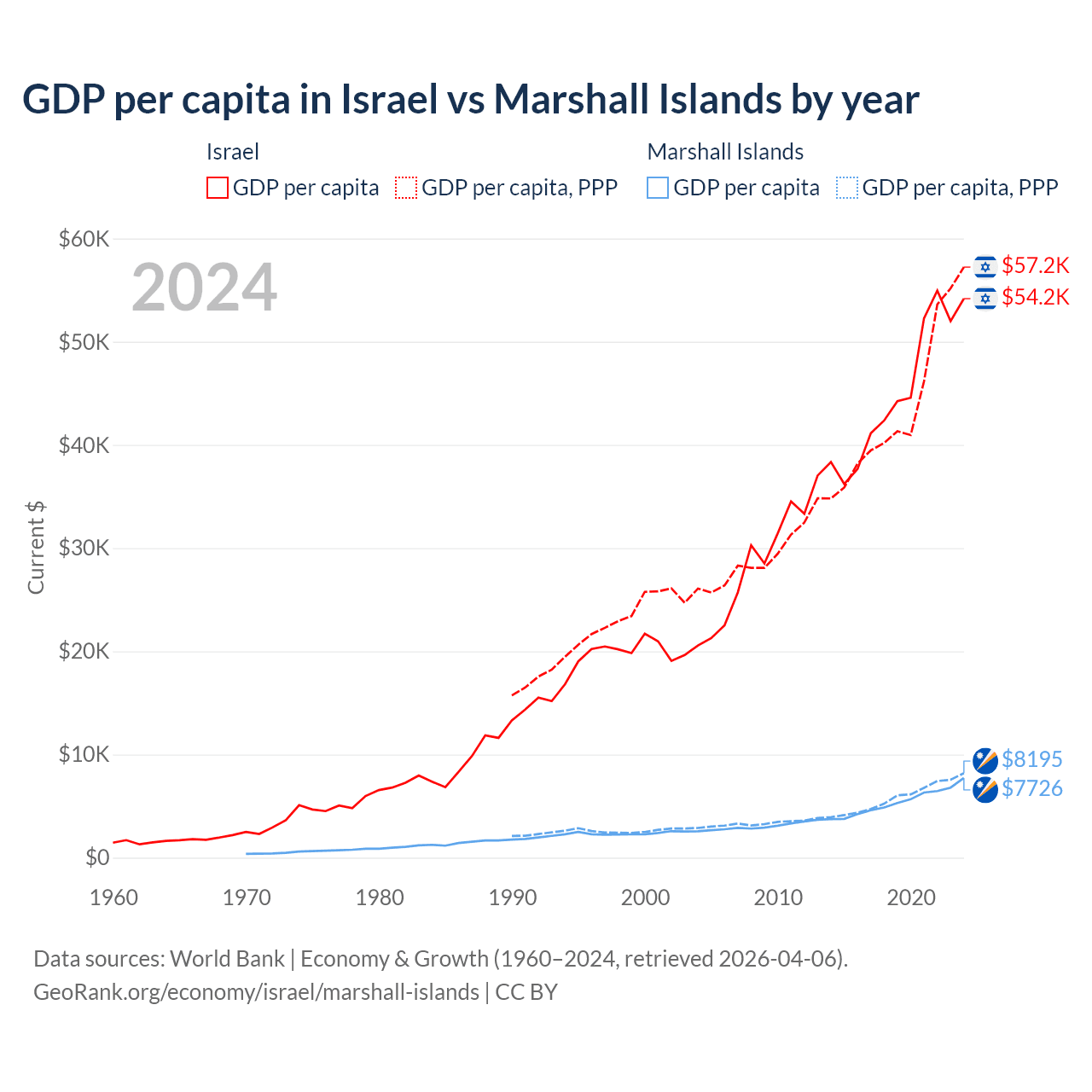
| Year | Current $ | |||
|---|---|---|---|---|
|
Israel
|
Marshall Islands
|
|||
| GDP per capita | GDP per capita, PPP | GDP per capita | GDP per capita, PPP | |
| 2025 | $60,337 | - | $8,489 | - |
| 2024 | $54,217 | $57,236 | $7,590 | $8,195 |
| 2023 | $52,126 | $55,171 | $6,799 | $7,549 |
| 2022 | $54,947 | $53,619 | $6,456 | $7,431 |
| 2021 | $52,258 | $46,162 | $6,315 | $6,768 |
| 2020 | $44,591 | $40,955 | $5,662 | $6,137 |
| 2019 | $44,092 | $41,325 | $5,292 | $6,045 |
| 2018 | $42,269 | $40,190 | $4,858 | $5,232 |
| 2017 | $41,013 | $39,471 | $4,593 | $4,719 |
| 2016 | $37,571 | $38,189 | $4,230 | $4,366 |
| 2015 | $36,138 | $35,871 | $3,764 | $4,125 |
| 2014 | $38,265 | $34,816 | $3,735 | $3,931 |
| 2013 | $36,981 | $34,827 | $3,678 | $3,845 |
| 2012 | $33,269 | $32,484 | $3,514 | $3,590 |
| 2011 | $34,477 | $31,314 | $3,319 | $3,537 |
| 2010 | $31,399 | $29,456 | $3,095 | $3,473 |
| 2009 | $28,470 | $28,087 | $2,907 | $3,253 |
| 2008 | $30,231 | $28,084 | $2,818 | $3,118 |
| 2007 | $25,689 | $28,307 | $2,892 | $3,309 |
| 2006 | $22,500 | $26,385 | $2,754 | $3,110 |
| 2005 | $21,262 | $25,701 | $2,659 | $3,017 |
| 2004 | $20,550 | $26,078 | $2,566 | $2,880 |
| 2003 | $19,624 | $24,702 | $2,539 | $2,824 |
| 2002 | $19,059 | $26,101 | $2,566 | $2,825 |
| 2001 | $20,949 | $25,806 | $2,394 | $2,700 |
| 2000 | $21,690 | $25,766 | $2,265 | $2,490 |
| 1999 | $19,809 | $23,415 | $2,258 | $2,400 |
| 1998 | $20,176 | $22,927 | $2,254 | $2,422 |
| 1997 | $20,457 | $22,279 | $2,231 | $2,434 |
| 1996 | $20,213 | $21,672 | $2,273 | $2,583 |
| 1995 | $19,014 | $20,642 | $2,491 | $2,858 |
| 1994 | $16,796 | $19,478 | $2,265 | $2,617 |
| 1993 | $15,169 | $18,218 | $2,112 | $2,452 |
| 1992 | $15,500 | $17,553 | $1,963 | $2,293 |
| 1991 | $14,337 | $16,486 | $1,811 | $2,131 |
| 1990 | $13,300 | $15,721 | $1,758 | $2,102 |
| 1989 | $11,601 | - | $1,670 | - |
| 1988 | $11,846 | - | $1,670 | - |
| 1987 | $9,847 | - | $1,543 | - |
| 1986 | $8,330 | - | $1,425 | - |
| 1985 | $6,824 | - | $1,162 | - |
| 1984 | $7,364 | - | $1,245 | - |
| 1983 | $7,955 | - | $1,199 | - |
| 1982 | $7,253 | - | $1,046 | - |
| 1981 | $6,791 | - | $969 | - |
| 1980 | $6,545 | - | $868 | - |
| 1979 | $5,968 | - | $859 | - |
| 1978 | $4,794 | - | $771 | - |
| 1977 | $5,050 | - | $724 | - |
| 1976 | $4,514 | - | $672 | - |
| 1975 | $4,669 | - | $638 | - |
| 1974 | $5,082 | - | $602 | - |
| 1973 | $3,629 | - | $472 | - |
| 1972 | $2,928 | - | $416 | - |
| 1971 | $2,297 | - | $390 | - |
| 1970 | $2,489 | - | $373 | - |
| 1969 | $2,188 | - | - | - |
| 1968 | $1,946 | - | - | - |
| 1967 | $1,734 | - | - | - |
| 1966 | $1,788 | - | - | - |
| 1965 | $1,688 | - | - | - |
| 1964 | $1,625 | - | - | - |
| 1963 | $1,485 | - | - | - |
| 1962 | $1,293 | - | - | - |
| 1961 | $1,696 | - | - | - |
| 1960 | $1,452 | - | - | - |
Data sources: World Bank | Economy & Growth (1960–2025, retrieved 2026-07-08).
GeoRank.org/economy/israel/marshall-islands | CC BY
Israel's GDP per capita is $60,337, ranking 19/197, compared to $8,489 in the Marshall Islands, ranking 95/197. Adjusted for purchasing power (GDP per capita PPP), Israel ranks 36th at $57,236, while the Marshall Islands ranks 139th at $8,195.
Economic indicators
|
Israel
|
Marshall Islands
|
|
|---|---|---|
| Gross domestic product |
$611B
2025 |
$308M
2025 |
| GDP rank |
27/197
2025 |
194/197
2025 |
| GDP growth |
2.93%
2024-2025 |
2.28%
2024-2025 |
| GDP per capita |
$60,337
2025 |
$8,489
2025 |
| GDP per capita rank |
19/197
2025 |
95/197
2025 |
| GDP per capita, PPP |
$57,236
2024 |
$8,195
2024 |
| GDP per capita PPP rank |
36/197
2024 |
139/197
2024 |
| Government debt |
$418B
2025 |
$36.3M
2025 |
| Debt-to-GDP ratio |
68.5%
2025 |
11.8%
2025 |
| Government debt per person |
$41,338
2025 |
$1,000
2025 |
| Government debt per person rank |
16/185
2025 |
144/185
2025 |
| Average annual personal income after taxes |
$48,251
2026 |
$5,308
2026 |
| Market capitalization of domestic companies |
$331B
2024 |
n/a |
| Number of millionaires |
195,000
2026 |
n/a |
| Number of billionaires |
42
2026 |
n/a |
| Income share by richest 10% |
27%
2022 |
27.5%
2019 |
| Income share by poorest 10% |
1.8%
2022 |
2.8%
2019 |
| Government expenditure, % of GDP |
43.6%
2025 |
65.3%
2025 |
| Consumer prices inflation |
3.04%
2024-2025 |
5.5%
2024-2025 |
| Central bank interest rate |
3.75%
2026 |
n/a |
| Unemployment rate |
3%
2025 |
9.82%
2021 |
| Population |
10334048
|
35039
|
Spending and national debt comparison by year
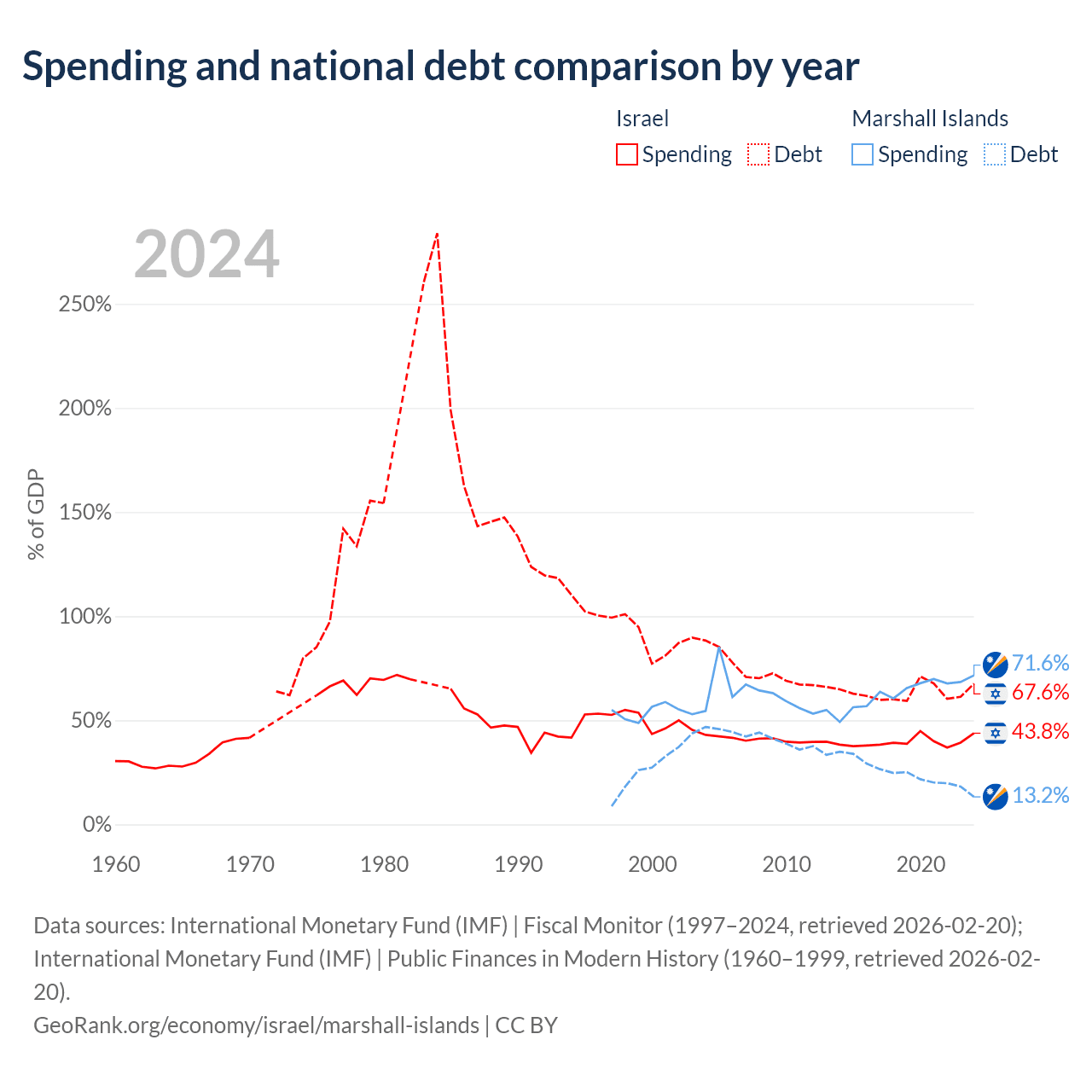
| Year | % of GDP | |||
|---|---|---|---|---|
|
Israel
|
Marshall Islands
|
|||
| Government spending | Government debt | Government spending | Government debt | |
| 2025 | 43.6% | 68.5% | 65.3% | 11.8% |
| 2024 | 43.7% | 67.7% | 70.9% | 14.2% |
| 2023 | 39.6% | 61.3% | 67.5% | 18.2% |
| 2022 | 36.9% | 60.3% | 65.8% | 19.6% |
| 2021 | 40.1% | 67.7% | 69.2% | 19.9% |
| 2020 | 44.8% | 71.1% | 67.8% | 21.7% |
| 2019 | 38.7% | 59.3% | 65.5% | 25.1% |
| 2018 | 39.2% | 60.1% | 60.5% | 24.7% |
| 2017 | 38.4% | 59.8% | 63.7% | 26.5% |
| 2016 | 37.9% | 61.7% | 56.8% | 29.2% |
| 2015 | 37.6% | 62.8% | 56.3% | 33.9% |
| 2014 | 38.3% | 65.8% | 49.2% | 34.9% |
| 2013 | 39.7% | 66% | 55% | 33.4% |
| 2012 | 39.6% | 66.9% | 53.2% | 37.6% |
| 2011 | 39.3% | 67.2% | 55.9% | 35.9% |
| 2010 | 39.7% | 69% | 59.2% | 38.8% |
| 2009 | 41.4% | 72.6% | 63.1% | 41.2% |
| 2008 | 41.2% | 70.2% | 64.3% | 44.1% |
| 2007 | 40.2% | 70.8% | 67.2% | 42.2% |
| 2006 | 41.6% | 77.7% | 61.2% | 44.4% |
| 2005 | 42.3% | 85.2% | 85.3% | 45.8% |
| 2004 | 43% | 88.3% | 54.5% | 46.8% |
| 2003 | 45.4% | 89.7% | 52.9% | 43.7% |
| 2002 | 50% | 87.2% | 55.2% | 37.2% |
| 2001 | 46.1% | 81.1% | 58.8% | 32.7% |
| 2000 | 43.4% | 77.2% | 56.5% | 27.3% |
| 1999 | 53.6% | 94.8% | 48.7% | 26.1% |
| 1998 | 55% | 101% | 50.5% | 18.1% |
| 1997 | 52.6% | 99.3% | 55% | 8.73% |
| 1996 | 53.2% | 100.3% | - | - |
| 1995 | 52.8% | 102.3% | - | - |
| 1994 | 41.7% | 110.2% | - | - |
| 1993 | 42.2% | 118.3% | - | - |
| 1992 | 44.1% | 119.6% | - | - |
| 1991 | 34.4% | 123.7% | - | - |
| 1990 | 46.8% | 138.3% | - | - |
| 1989 | 47.5% | 147.4% | - | - |
| 1988 | 46.5% | 145.4% | - | - |
| 1987 | 52.8% | 143.2% | - | - |
| 1986 | 55.7% | 162.5% | - | - |
| 1985 | 65.2% | 199% | - | - |
| 1984 | - | 284% | - | - |
| 1983 | - | 260.5% | - | - |
| 1982 | 69.7% | - | - | - |
| 1981 | 71.8% | - | - | - |
| 1980 | 69.4% | 154.3% | - | - |
| 1979 | 70.1% | 155.5% | - | - |
| 1978 | 62.2% | 133.6% | - | - |
| 1977 | 69.1% | 142% | - | - |
| 1976 | 66.3% | 97.4% | - | - |
| 1975 | 62% | 85.1% | - | - |
| 1974 | - | 79.8% | - | - |
| 1973 | - | 62.1% | - | - |
| 1972 | - | 63.9% | - | - |
| 1971 | - | - | - | - |
| 1970 | 41.6% | - | - | - |
| 1969 | 41.1% | - | - | - |
| 1968 | 39.4% | - | - | - |
| 1967 | 33.9% | - | - | - |
| 1966 | 29.6% | - | - | - |
| 1965 | 27.8% | - | - | - |
| 1964 | 28.2% | - | - | - |
| 1963 | 26.9% | - | - | - |
| 1962 | 27.7% | - | - | - |
| 1961 | 30.3% | - | - | - |
| 1960 | 30.4% | - | - | - |
Data sources: International Monetary Fund (IMF) | Fiscal Monitor (1997–2025, retrieved 2026-07-08); International Monetary Fund (IMF) | Public Finances in Modern History (1960–1999, retrieved 2026-07-08).
GeoRank.org/economy/israel/marshall-islands | CC BY
In 2025, Israel's government spending was $266B, accounting for 43.6% of its GDP, while the Marshall Islands spent $201M, or 65.3% of GDP.
Debt-to-GDP ratio is 68.5% in Israel and 11.8% in the Marshall Islands, ranking 60/185 and 180/185, respectively.
Government deficit by year
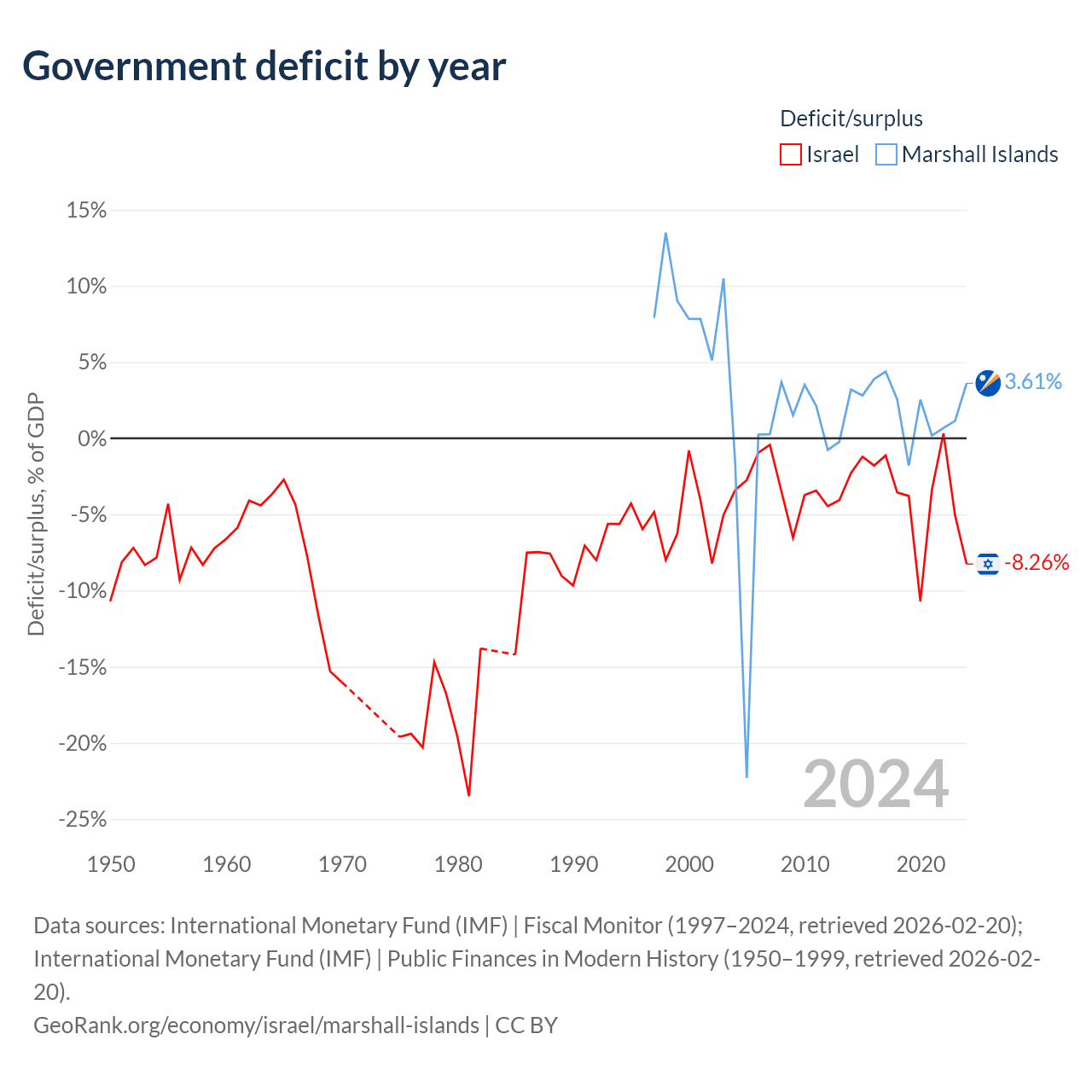
| Year | Deficit/surplus, % of GDP | |
|---|---|---|
|
Israel
|
Marshall Islands
|
|
| 2025 | -5.22% | 1.35% |
| 2024 | -8.07% | 2.62% |
| 2023 | -5.38% | 1.01% |
| 2022 | 0.3% | 0.51% |
| 2021 | -3.37% | 0.18% |
| 2020 | -10.6% | 2.54% |
| 2019 | -3.79% | -1.8% |
| 2018 | -3.58% | 2.55% |
| 2017 | -1.17% | 4.38% |
| 2016 | -1.78% | 3.88% |
| 2015 | -1.2% | 2.81% |
| 2014 | -2.28% | 3.2% |
| 2013 | -4.07% | -0.23% |
| 2012 | -4.46% | -0.76% |
| 2011 | -3.43% | 2.13% |
| 2010 | -3.72% | 3.51% |
| 2009 | -6.53% | 1.51% |
| 2008 | -3.49% | 3.68% |
| 2007 | -0.43% | 0.27% |
| 2006 | -0.94% | 0.24% |
| 2005 | -2.74% | -22.3% |
| 2004 | -3.4% | -1.6% |
| 2003 | -5.03% | 10.5% |
| 2002 | -8.21% | 5.12% |
| 2001 | -4.06% | 7.83% |
| 2000 | -0.8% | 7.84% |
| 1999 | -6.26% | 9.01% |
| 1998 | -7.99% | 13.5% |
| 1997 | -4.84% | 7.91% |
| 1996 | -5.97% | - |
| 1995 | -4.28% | - |
| 1994 | -5.62% | - |
| 1993 | -5.62% | - |
| 1992 | -8% | - |
| 1991 | -7.04% | - |
| 1990 | -9.67% | - |
| 1989 | -9.03% | - |
| 1988 | -7.57% | - |
| 1987 | -7.47% | - |
| 1986 | -7.51% | - |
| 1985 | -14.2% | - |
| 1984 | - | - |
| 1983 | - | - |
| 1982 | -13.8% | - |
| 1981 | -23.5% | - |
| 1980 | -19.6% | - |
| 1979 | -16.7% | - |
| 1978 | -14.7% | - |
| 1977 | -20.3% | - |
| 1976 | -19.4% | - |
| 1975 | -19.6% | - |
| 1974 | - | - |
| 1973 | - | - |
| 1972 | - | - |
| 1971 | - | - |
| 1970 | -16% | - |
| 1969 | -15.3% | - |
| 1968 | -11.7% | - |
| 1967 | -7.68% | - |
| 1966 | -4.35% | - |
| 1965 | -2.72% | - |
| 1964 | -3.65% | - |
| 1963 | -4.41% | - |
| 1962 | -4.09% | - |
| 1961 | -5.86% | - |
| 1960 | -6.62% | - |
| 1959 | -7.23% | - |
| 1958 | -8.31% | - |
| 1957 | -7.17% | - |
| 1956 | -9.3% | - |
| 1955 | -4.3% | - |
| 1954 | -7.84% | - |
| 1953 | -8.32% | - |
| 1952 | -7.19% | - |
| 1951 | -8.13% | - |
| 1950 | -10.7% | - |
Data sources: International Monetary Fund (IMF) | Fiscal Monitor (1997–2025, retrieved 2026-07-08); International Monetary Fund (IMF) | Public Finances in Modern History (1950–1999, retrieved 2026-07-08).
GeoRank.org/economy/israel/marshall-islands | CC BY
In 2025, Israel's government deficit, the difference between spending and revenue, was $31.9B, equivalent to 5.22% of GDP. This compares to the Marshall Islands' surplus of $4.17M, or 1.35% of GDP.
Over the past 29 years, Israel recorded a fiscal deficit in 28 of those years, while the Marshall Islands ran a deficit in 5 years. On average, Israel posted an annual deficit equal to 4.02% of GDP, compared to surplus of 2.46% of GDP for the Marshall Islands.
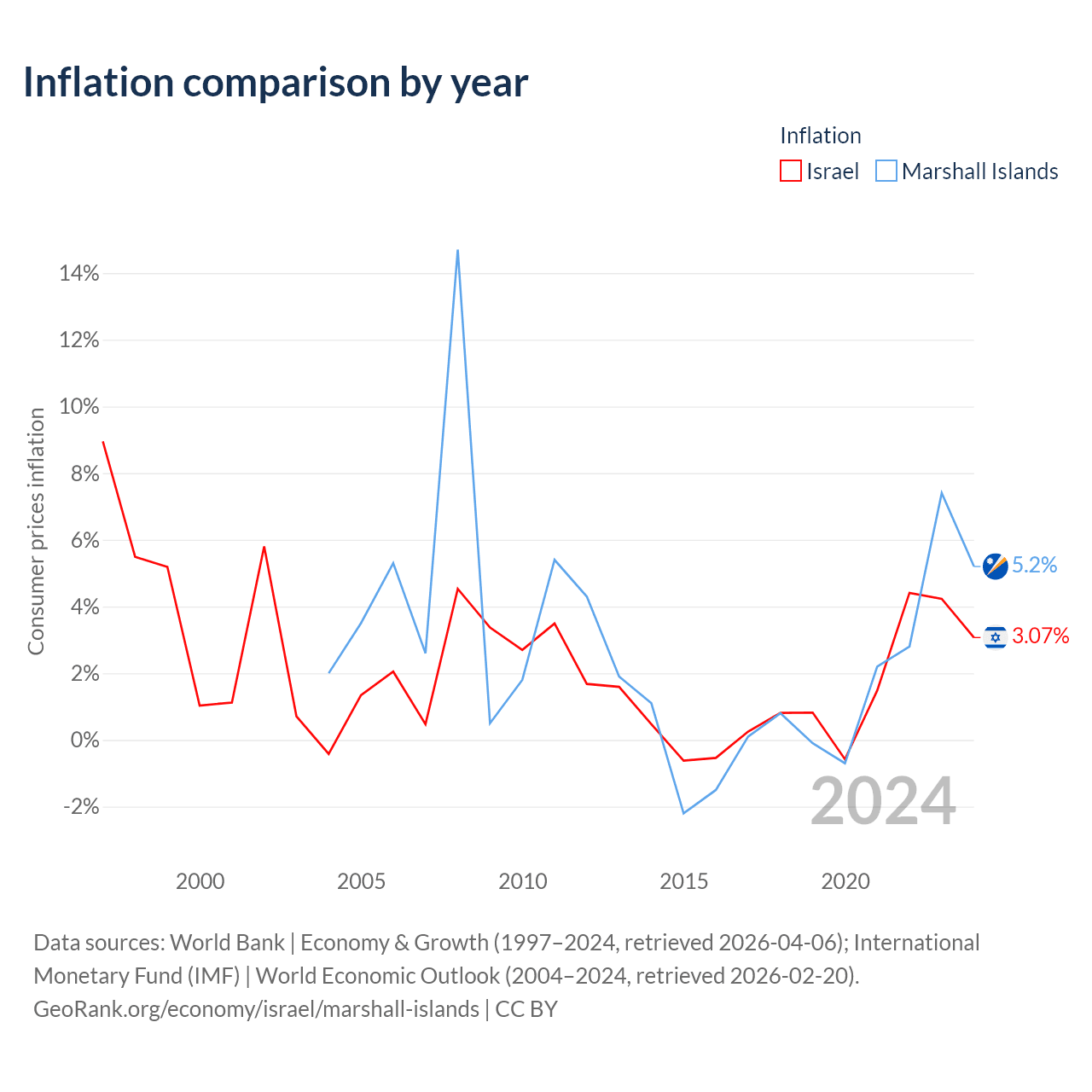
Inflation comparison by year
| Year | Consumer prices inflation | |
|---|---|---|
|
Israel
|
Marshall Islands
|
|
| 2025 | 3.04% | 5.5% |
| 2024 | 3.07% | 5.2% |
| 2023 | 4.23% | 7.4% |
| 2022 | 4.41% | 2.8% |
| 2021 | 1.48% | 2.2% |
| 2020 | -0.58% | -0.7% |
| 2019 | 0.82% | -0.1% |
| 2018 | 0.81% | 0.8% |
| 2017 | 0.25% | 0.1% |
| 2016 | -0.54% | -1.5% |
| 2015 | -0.62% | -2.2% |
| 2014 | 0.47% | 1.1% |
| 2013 | 1.59% | 1.9% |
| 2012 | 1.68% | 4.3% |
| 2011 | 3.49% | 5.4% |
| 2010 | 2.7% | 1.8% |
| 2009 | 3.37% | 0.5% |
| 2008 | 4.53% | 14.7% |
| 2007 | 0.47% | 2.6% |
| 2006 | 2.05% | 5.3% |
| 2005 | 1.34% | 3.5% |
| 2004 | -0.42% | 2% |
| 2003 | 0.71% | - |
| 2002 | 5.8% | - |
| 2001 | 1.12% | - |
| 2000 | 1.03% | - |
| 1999 | 5.19% | - |
| 1998 | 5.49% | - |
| 1997 | 8.95% | - |
Data sources: World Bank | Economy & Growth (1997–2025, retrieved 2026-07-08); International Monetary Fund (IMF) | World Economic Outlook (2004–2025, retrieved 2026-07-08).
GeoRank.org/economy/israel/marshall-islands | CC BY
Over the past 22 years, Israel has recorded an average annual inflation rate of 1.71%, compared with 2.85% in the Marshall Islands. In 2025, inflation was 3.04% in Israel and 5.5% in the Marshall Islands.
Top exports between countries
|
Israel
|
|
|---|---|
| Export category | Export value |
| Machinery & equipment | $109K |
|
Marshall Islands
|
|
|---|---|
| Export category | Export value |
| Raw materials & minerals | $79K |
| Textiles & consumer goods | $25K |
Balance of trade
|
Israel
|
Marshall Islands
|
|
|---|---|---|
|
Current account balance
|
$8.53B
2025 |
$62.3M
2024 |
| Current account balance ranking |
26/190
2025 |
67/190
2024 |
| Current account balance, % of GDP |
+1.4%
2025 |
+21.9%
2024 |
| Goods imports |
$102B
2025 |
$173M
2024 |
| Goods exports |
$76.2B
2025 |
$101M
2024 |
| Service imports |
$53.2B
2025 |
$64.2M
2024 |
| Service exports |
$92.4B
2025 |
$21.1M
2024 |
| Imports of goods and services, % of GDP |
25.4%
2025 |
79.9%
2025 |
| Exports of goods and services, % of GDP |
27.6%
2025 |
36%
2025 |
Economic freedom indices
The indices of economic freedom below are issued by the Heritage Foundation. Higher scores indicate stronger economic health.
|
Israel
|
Marshall Islands
|
|
|---|---|---|
| Economic freedom | 68.4 | 58 |
| Economic freedom ranking | 47/197 | 113/197 |
| Property rights | 73.1 | n/a |
| Government integrity | 66.2 | n/a |
| Judicial effectiveness | 68.1 | n/a |
| Tax burden | 60.2 | n/a |
| Government spending | 52 | n/a |
| Fiscal health | 60.8 | n/a |
| Business freedom | 72.4 | n/a |
| Labor freedom | 56.8 | n/a |
| Monetary freedom | 78.2 | n/a |
| Trade freedom | 82.8 | n/a |
| Investment freedom | 70 | n/a |
| Financial freedom | 80 | n/a |
Other economic metrics
|
Israel
|
Marshall Islands
|
|
|---|---|---|
| Services, % of GDP |
72.8%
2024 |
68.2%
2024 |
| Industry, % of GDP |
17.2%
2024 |
13.4%
2024 |
| Agriculture, forestry, and fishing, % of GDP |
1.29%
2024 |
19.9%
2024 |
|
GNI, Atlas method
|
$569B
2025 |
$352M
2025 |
| GNI per capita, PPP |
$58,870
2025 |
$10,590
2025 |
| Total reserves including gold |
$229B
2025 |
n/a |
| Total reserves ranking |
18/177
2025 |
n/a |
|
Net foreign direct investment
|
-$11.8B
2025 |
-$13.4M
2024 |
|
Net inflows of foreign direct investment
|
$14.8B
2024 |
$13.4M
2024 |
|
Net outflows of foreign direct investment
|
$9.92B
2024 |
$0
2024 |
| Poverty at national poverty lines |
22%
2020 |
7.2%
2019 |
|
Gross capital formation, % of GDP
|
24.3%
2025 |
21.1%
2024 |
GDP per capita map

Data sources: World Bank | Economy & Growth (1985–2025, retrieved 2026-07-08); U.S. Census Bureau (1985–2025, retrieved 2026-07-08).
GeoRank.org/economy/israel/marshall-islands | CC BY
Compare countries by 7 more topics
Help us show the world through your eyes
Share a photo of your city and help others discover what it looks like to live there. Your contribution makes our data come alive.
Data sources:
- World Bank | Economy & Growth (1960–2025, retrieved 2026-07-08)
- International Monetary Fund (IMF) | Fiscal Monitor (1997–2025, retrieved 2026-07-08)
- International Monetary Fund (IMF) | Public Finances in Modern History (1950–1999, retrieved 2026-07-08)
- U.S. Census Bureau (1985–2025, retrieved 2026-07-08)
- The Heritage Foundation | Economic Freedom Index (2026, retrieved 2026-07-08)
- TradeMap (2024–2025, retrieved 2026-07-08)
- United Nations | World Population Prospects (2026, retrieved 2026-07-08)
- LivingCost (2026, retrieved 2026-07-08)
- Central Intelligence Agency (CIA) (2020, retrieved 2026-07-08)
Creative Commons Attribution (CC BY) — you’re free to copy, share, remix, adapt, and use even commercially as long as you give appropriate credit and clearly indicate if you made changes. Other sources may be subject to different license terms.
The current account balance is the sum of net trade in goods and services, net earnings from cross-border investments, and net transfer payments. It reflects a country's economic transactions with the rest of the world and is a fundamental component of the balance of payments. A surplus indicates that a country exports more than it imports, while a deficit shows the opposite.
Gross National Income (GNI) measures a country's total income. It encompasses income earned by residents, businesses, and foreign sources, defined as employee compensation and investment profits. GNI adds product taxes not included elsewhere and subtracts subsidies. It accounts for income from residents working abroad but excludes earnings from foreigners within the country.
A negative value for Net Foreign Direct Investment indicates a country is a net receiver of investments, as foreign inflows exceed outflows after Balance of Payments adjustments. A positive value indicates a net provider, with outflows exceeding inflows. Inflows are credits (increasing foreign claims on domestic assets), while outflows are debits (increasing domestic assets abroad).
Foreign direct investment (FDI, net inflows) shows how much capital foreign investors bring into a country after accounting for any funds that flow back in the opposite direction. It represents the net value of overseas companies establishing, expanding, or financing businesses in the reporting country. A positive number means more capital entered the country than was withdrawn, while a negative number means foreign investors pulled out more than they invested.
Foreign direct investment (FDI, net outflows) shows how much capital residents of a country invest abroad after accounting for any funds that flow back in the opposite direction. It represents the net value of domestic companies establishing, expanding, or financing businesses in other countries. A positive number means more capital was invested abroad than withdrawn, while a negative number means residents pulled back more than they invested.
Formerly gross domestic investment, gross capital formation measures the share of a country’s economic output invested in fixed assets, including buildings, machinery, and infrastructure. It indicates how much of the economy is devoted to building productive capacity.