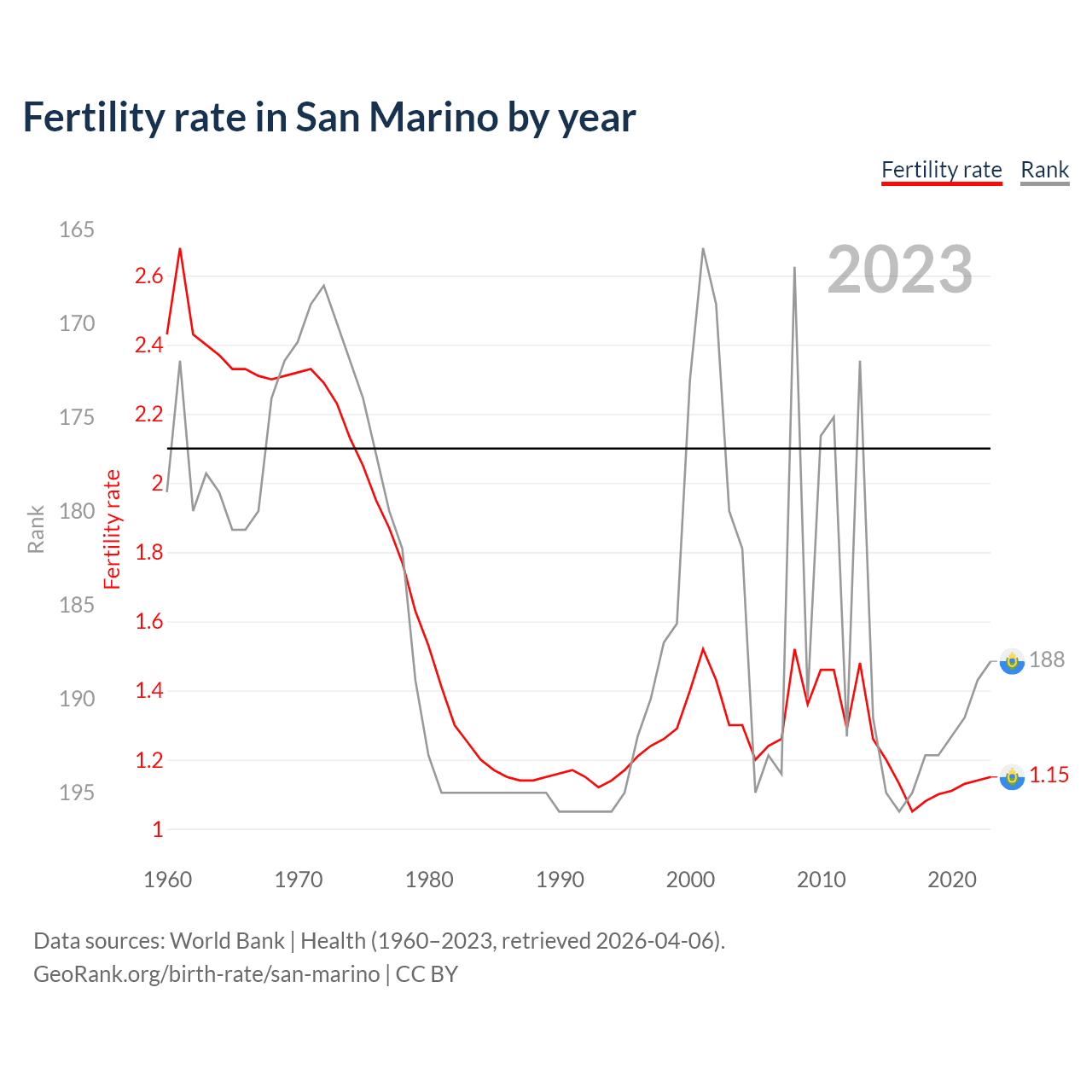
San Marino has a birth rate of 4.2 (annual births per 1,000 people) and a fertility rate of 1.16 (the average number of children a woman is expected to have over her lifetime based on current age-specific birth rates).
In 1960, the fertility rate in San Marino was 2.43 children per woman — 2.1 times higher than in 2024.
San Marino birth rate statistics:
- San Marino is ranked 196/196 by birth rate now and was ranked 181/194 in 1960.
- The mean age at first birth in San Marino is 31.5 — it was 30.1 in 2001.
- The mean age at childbearing (for all the births, not just the first) is 32.8, a change from 28.9 in 1990.
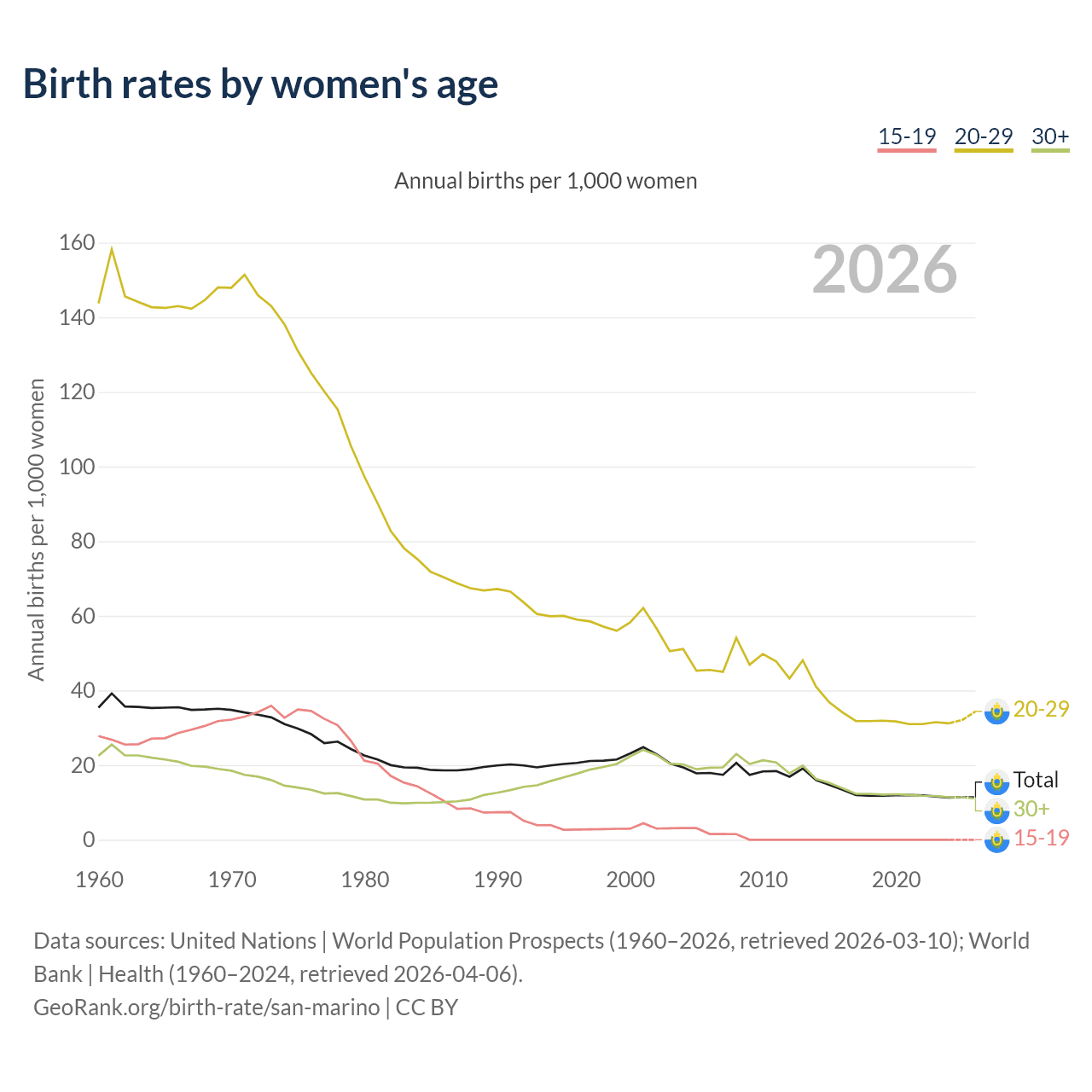
- Annual births per 1,000 women ages 15-19 (adolescent birth rate or teenage mother rate) changed from 26.2 in 1960 to 1.17 in 2024.
- 19.4% of the population in 2025 is composed of women of reproductive age (15-49), a change from 24.4% in 1960.
Fertility rate in San Marino by year
| Year | Fertility rate | Rank |
|---|---|---|
| 2024 | 1.16 | 184 |
| 2023 | 1.15 | 188 |
| 2022 | 1.14 | 189 |
| 2021 | 1.13 | 191 |
| 2020 | 1.11 | 192 |
| 2019 | 1.1 | 193 |
| 2018 | 1.08 | 193 |
| 2017 | 1.05 | 195 |
| 2016 | 1.13 | 196 |
| 2015 | 1.2 | 195 |
| 2014 | 1.26 | 191 |
| 2013 | 1.48 | 172 |
| 2012 | 1.29 | 192 |
| 2011 | 1.46 | 175 |
| 2010 | 1.46 | 176 |
| 2009 | 1.36 | 190 |
| 2008 | 1.52 | 167 |
| 2007 | 1.26 | 194 |
| 2006 | 1.24 | 193 |
| 2005 | 1.2 | 195 |
| 2004 | 1.3 | 182 |
| 2003 | 1.3 | 180 |
| 2002 | 1.43 | 169 |
| 2001 | 1.52 | 166 |
| 2000 | 1.4 | 173 |
| 1999 | 1.29 | 186 |
| 1998 | 1.26 | 187 |
| 1997 | 1.24 | 190 |
| 1996 | 1.21 | 192 |
| 1995 | 1.17 | 195 |
| 1994 | 1.14 | 196 |
| 1993 | 1.12 | 196 |
| 1992 | 1.15 | 196 |
| 1991 | 1.17 | 196 |
| 1990 | 1.16 | 196 |
| 1989 | 1.15 | 195 |
| 1988 | 1.14 | 195 |
| 1987 | 1.14 | 195 |
| 1986 | 1.15 | 195 |
| 1985 | 1.17 | 195 |
| 1984 | 1.2 | 195 |
| 1983 | 1.25 | 195 |
| 1982 | 1.3 | 195 |
| 1981 | 1.41 | 195 |
| 1980 | 1.53 | 193 |
| 1979 | 1.63 | 189 |
| 1978 | 1.77 | 182 |
| 1977 | 1.87 | 180 |
| 1976 | 1.95 | 177 |
| 1975 | 2.05 | 174 |
| 1974 | 2.13 | 172 |
| 1973 | 2.23 | 170 |
| 1972 | 2.29 | 168 |
| 1971 | 2.33 | 169 |
| 1970 | 2.32 | 171 |
| 1969 | 2.31 | 172 |
| 1968 | 2.3 | 174 |
| 1967 | 2.31 | 180 |
| 1966 | 2.33 | 181 |
| 1965 | 2.33 | 181 |
| 1964 | 2.37 | 179 |
| 1963 | 2.4 | 178 |
| 1962 | 2.43 | 180 |
| 1961 | 2.68 | 172 |
| 1960 | 2.43 | 179 |
Data sources: World Bank | Health (1960–2024, retrieved 2026-07-08).
GeoRank.org/birth-rate/san-marino | CC BY 
According to the latest birth rate data available, the fertility rate in San Marino was 1.16 in 2024 and has been below the replacement level of 2.1 children per woman since 1975. In 1994, the fertility rate was 1.14 — a 1.76% increase in 30 years.
Check population clock for a dynamic visualization of the changing population.
The chart above shows the historical changes in fertility rate and ranking compared to other countries, where a lower rank number indicates a higher relative fertility rate.
Births, deaths, and natural population change by year
| Year | People | ||
|---|---|---|---|
| Natural change | Births | Deaths | |
| 2024 | -112 | 142 | 254 |
| 2023 | -92 | 189 | 281 |
| 2022 | -58 | 205 | 263 |
| 2021 | -99 | 212 | 311 |
| 2020 | -122 | 222 | 344 |
| 2019 | -17 | 232 | 249 |
| 2018 | -11 | 234 | 245 |
| 2017 | -51 | 226 | 277 |
| 2016 | 10 | 261 | 251 |
| 2015 | 36 | 269 | 233 |
| 2014 | 46 | 297 | 251 |
| 2013 | 73 | 320 | 247 |
| 2012 | 54 | 291 | 237 |
| 2011 | 105 | 326 | 221 |
| 2010 | 126 | 342 | 216 |
| 2009 | 145 | 353 | 208 |
| 2008 | 159 | 348 | 189 |
| 2007 | 69 | 293 | 224 |
| 2006 | 75 | 301 | 226 |
| 2005 | 66 | 283 | 217 |
| 2004 | 121 | 306 | 185 |
| 2003 | 79 | 296 | 217 |
| 2002 | 112 | 328 | 216 |
| 2001 | 132 | 347 | 215 |
| 2000 | 107 | 321 | 214 |
| 1999 | 80 | 294 | 214 |
| 1998 | 74 | 287 | 213 |
| 1997 | 71 | 282 | 211 |
| 1996 | 63 | 274 | 211 |
| 1995 | 51 | 262 | 211 |
| 1994 | 43 | 252 | 209 |
| 1993 | 38 | 244 | 206 |
| 1992 | 42 | 245 | 203 |
| 1991 | 45 | 244 | 199 |
| 1990 | 41 | 237 | 196 |
| 1989 | 36 | 228 | 192 |
| 1988 | 34 | 222 | 188 |
| 1987 | 31 | 217 | 186 |
| 1986 | 40 | 214 | 174 |
| 1985 | 44 | 214 | 170 |
| 1984 | 46 | 215 | 169 |
| 1983 | 54 | 219 | 165 |
| 1982 | 61 | 223 | 162 |
| 1981 | 76 | 236 | 160 |
| 1980 | 90 | 249 | 159 |
| 1979 | 104 | 260 | 156 |
| 1978 | 121 | 275 | 154 |
| 1977 | 117 | 259 | 142 |
| 1976 | 126 | 267 | 141 |
| 1975 | 141 | 281 | 140 |
| 1974 | 153 | 293 | 140 |
| 1973 | 167 | 307 | 140 |
| 1972 | 173 | 310 | 137 |
| 1971 | 174 | 308 | 134 |
| 1970 | 173 | 308 | 135 |
| 1969 | 173 | 308 | 135 |
| 1968 | 171 | 305 | 134 |
| 1967 | 171 | 305 | 134 |
| 1966 | 173 | 306 | 133 |
| 1965 | 169 | 301 | 132 |
| 1964 | 163 | 295 | 132 |
| 1963 | 158 | 290 | 132 |
| 1962 | 155 | 286 | 131 |
| 1961 | 174 | 306 | 132 |
| 1960 | 139 | 270 | 131 |
Data sources: World Bank | Health (1960–2024, retrieved 2026-07-08).
GeoRank.org/birth-rate/san-marino | CC BY
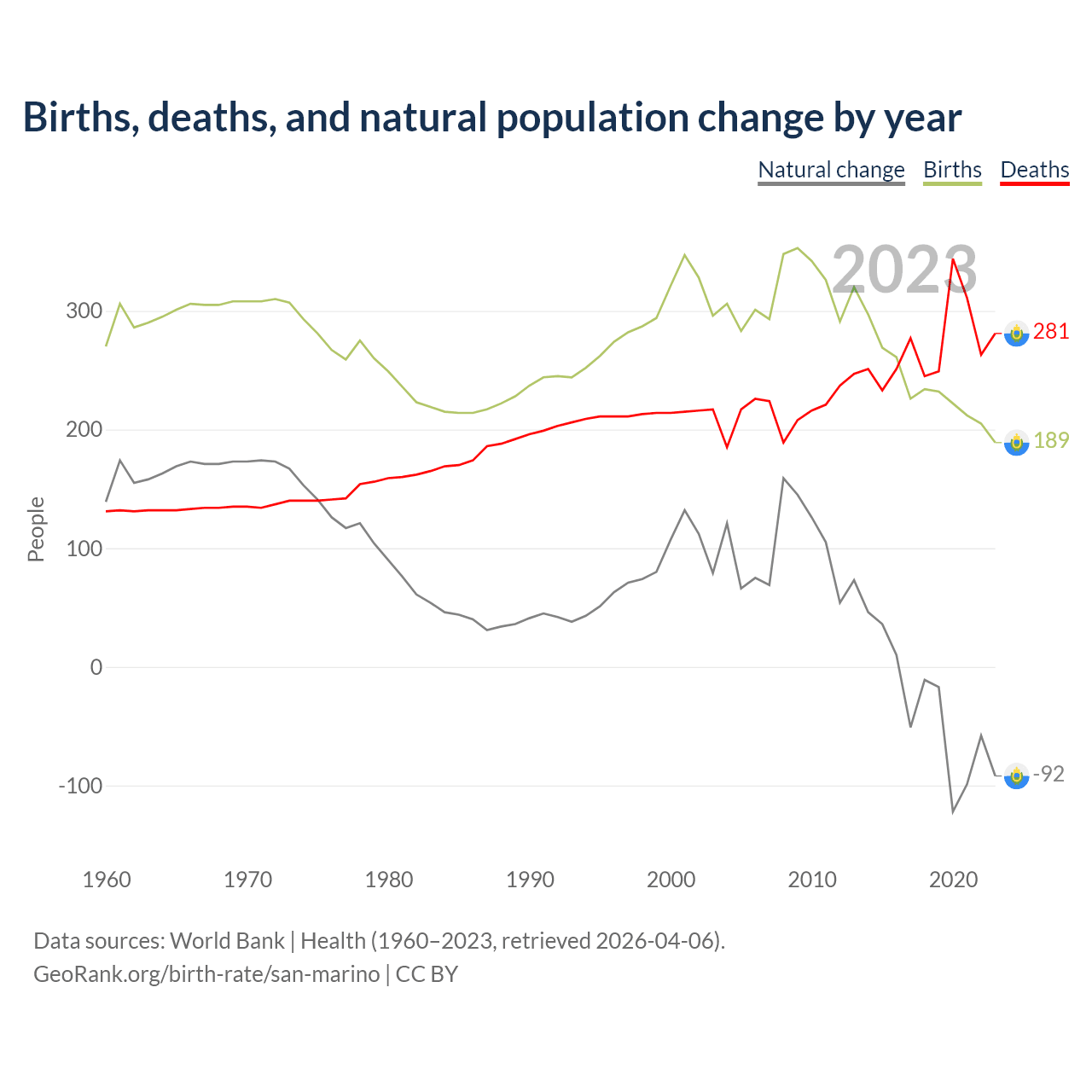
Over the past 10 years, the natural population change in San Marino (from births and deaths only, excluding migration) has been -0.15% annually. On average, 51 more people died each year than were born.
Excluding migration, the natural population change due to births and deaths from 2023 to 2024 was -0.33% — 112 more people died than were born.
In 2024, San Marino ranks 159/196 for absolute natural population change and 178/196 for natural change rate, where a lower rank number indicates faster natural growth and a higher number indicates greater decline.
Birth rates in San Marino compared to other countries
 San Marino
|
Rank | |
|---|---|---|
|
Fertility rate
|
1.16 | 184/196 |
|
Birth rate
|
4.2 | 196/196 |
| Population change due to births and deaths | -112 | 159/196 |
| Natural population change rate | -0.33% | 178/196 |
| Population growth | +0.39% | 140/197 |
| Age at first childbirth | 31.5 years | 6/137 |
| Average age at childbearing | 32.8 years | 2/197 |
| Annual births per 1,000 women ages 15-19 | 0 | 196/197 |
| Annual births per 1,000 women ages 20-29 | 34.4 | 192/197 |
| Annual births per 1,000 women ages 30+ | 11 | 185/197 |
| Female of reproductive age (15-49), share of population | 19.4% | 192/196 |
| Maternal mortality per live birth | 0.008% | 155/193 |
| Neonatal mortality rate (before reaching 28 days of age) | 0.05% | 193/193 |
| Infant mortality rate (before reaching 1 year of age) | 0.12% | 196/196 |
| Mortality rate before reaching 5 years of age | 0.13% | 192/192 |
| Life expectancy | 86 years | 2/197 |
Birth rates by women's age
Annual births per 1,000 women
| Year | Annual births per 1,000 women | |||
|---|---|---|---|---|
| Total | 15-19 | 20-29 | 30+ | |
| 2026 | 11.3 | 0 | 34.4 | 11 |
| 2025 | 11.3 | 0 | 32.1 | 11.4 |
| 2024 | 11.3 | 0 | 31.2 | 11.4 |
| 2023 | 11.6 | 0 | 31.5 | 11.7 |
| 2022 | 11.9 | 0 | 31 | 11.8 |
| 2021 | 12 | 0 | 31 | 12 |
| 2020 | 11.9 | 0 | 31.7 | 12.2 |
| 2019 | 11.8 | 0 | 31.9 | 12.1 |
| 2018 | 11.8 | 0 | 31.8 | 12.3 |
| 2017 | 12 | 0 | 31.8 | 12.3 |
| 2016 | 13.4 | 0 | 34.1 | 13.8 |
| 2015 | 14.7 | 0 | 36.8 | 15.2 |
| 2014 | 16 | 0 | 41 | 16.3 |
| 2013 | 19.1 | 0 | 48.1 | 19.9 |
| 2012 | 16.9 | 0 | 43.2 | 17.8 |
| 2011 | 18.4 | 0 | 47.8 | 20.7 |
| 2010 | 18.3 | 0 | 49.8 | 21.3 |
| 2009 | 17.4 | 0 | 46.9 | 20.3 |
| 2008 | 20.6 | 1.5 | 54.1 | 23 |
| 2007 | 17.4 | 1.52 | 45 | 19.4 |
| 2006 | 17.9 | 1.55 | 45.5 | 19.3 |
| 2005 | 17.8 | 3.12 | 45.3 | 18.9 |
| 2004 | 19.4 | 3.12 | 51.1 | 20.2 |
| 2003 | 20.5 | 3.07 | 50.5 | 20.4 |
| 2002 | 22.9 | 2.99 | 56.6 | 22.7 |
| 2001 | 24.8 | 4.42 | 62.1 | 24.1 |
| 2000 | 23.1 | 2.95 | 58.2 | 22.3 |
| 1999 | 21.5 | 2.94 | 56 | 20.3 |
| 1998 | 21.2 | 2.85 | 57.1 | 19.5 |
| 1997 | 21.1 | 2.79 | 58.5 | 18.8 |
| 1996 | 20.6 | 2.75 | 59 | 17.7 |
| 1995 | 20.3 | 2.68 | 60 | 16.7 |
| 1994 | 19.9 | 3.97 | 59.9 | 15.7 |
| 1993 | 19.4 | 3.91 | 60.5 | 14.6 |
| 1992 | 19.9 | 5.1 | 63.6 | 14.2 |
| 1991 | 20.2 | 7.43 | 66.5 | 13.3 |
| 1990 | 19.9 | 7.37 | 67.2 | 12.6 |
| 1989 | 19.5 | 7.29 | 66.8 | 12 |
| 1988 | 18.9 | 8.42 | 67.4 | 10.8 |
| 1987 | 18.6 | 8.26 | 68.7 | 10.3 |
| 1986 | 18.6 | 10.4 | 70.3 | 10.1 |
| 1985 | 18.7 | 12.4 | 71.8 | 9.93 |
| 1984 | 19.3 | 14.3 | 75.2 | 9.91 |
| 1983 | 19.4 | 15.3 | 78.1 | 9.75 |
| 1982 | 20 | 17.1 | 82.7 | 9.92 |
| 1981 | 21.5 | 20.4 | 90.2 | 10.8 |
| 1980 | 22.6 | 21.2 | 97.4 | 10.8 |
| 1979 | 24.3 | 26.5 | 105.5 | 11.7 |
| 1978 | 26.3 | 30.7 | 115.3 | 12.5 |
| 1977 | 25.9 | 32.4 | 120.1 | 12.4 |
| 1976 | 28.3 | 34.5 | 125.1 | 13.4 |
| 1975 | 29.8 | 34.9 | 131 | 14 |
| 1974 | 31 | 32.7 | 138.1 | 14.5 |
| 1973 | 32.8 | 35.9 | 143 | 16 |
| 1972 | 33.5 | 34.2 | 145.9 | 16.9 |
| 1971 | 34.1 | 33 | 151.4 | 17.4 |
| 1970 | 34.8 | 32.2 | 147.9 | 18.5 |
| 1969 | 35.1 | 31.8 | 148 | 19 |
| 1968 | 34.9 | 30.5 | 144.6 | 19.6 |
| 1967 | 34.8 | 29.5 | 142.3 | 19.8 |
| 1966 | 35.5 | 28.6 | 143 | 20.9 |
| 1965 | 35.4 | 27.2 | 142.5 | 21.5 |
| 1964 | 35.3 | 27.1 | 142.7 | 22 |
| 1963 | 35.6 | 25.6 | 144.1 | 22.6 |
| 1962 | 35.7 | 25.5 | 145.6 | 22.6 |
| 1961 | 39.2 | 26.8 | 158.2 | 25.5 |
| 1960 | 35.4 | 27.8 | 143.7 | 22.5 |
Data sources: United Nations | World Population Prospects (1960–2026, retrieved 2026-07-08); World Bank | Health (1960–2025, retrieved 2026-07-08).
GeoRank.org/birth-rate/san-marino | CC BY
Above is a chart displaying birth rates in San Marino by maternal age. In 2026, of all live births, 0% will be to women under age 20, 29.1% to women ages 20-29, and 70.9% to women ages 30 and above. The respective shares in 1990 were 2.52%, 59.7%, and 37.8%.
Children 0-14 years as share of population by year
| Year | Children 0-14 as share of population | |
|---|---|---|
|
San Marino
|
 World
World
|
|
| 2100 | 11.9% | 16.5% |
| 2099 | 11.9% | 16.6% |
| 2098 | 11.9% | 16.6% |
| 2097 | 12% | 16.7% |
| 2096 | 12% | 16.8% |
| 2095 | 12% | 16.8% |
| 2094 | 12.1% | 16.9% |
| 2093 | 12.1% | 17% |
| 2092 | 12.2% | 17% |
| 2091 | 12.2% | 17.1% |
| 2090 | 12.3% | 17.2% |
| 2089 | 12.3% | 17.2% |
| 2088 | 12.3% | 17.3% |
| 2087 | 12.4% | 17.4% |
| 2086 | 12.4% | 17.4% |
| 2085 | 12.4% | 17.5% |
| 2084 | 12.4% | 17.5% |
| 2083 | 12.4% | 17.6% |
| 2082 | 12.4% | 17.7% |
| 2081 | 12.3% | 17.7% |
| 2080 | 12.3% | 17.8% |
| 2079 | 12.2% | 17.8% |
| 2078 | 12.2% | 17.9% |
| 2077 | 12.1% | 17.9% |
| 2076 | 12% | 18% |
| 2075 | 11.9% | 18% |
| 2074 | 11.8% | 18.1% |
| 2073 | 11.7% | 18.2% |
| 2072 | 11.6% | 18.2% |
| 2071 | 11.5% | 18.3% |
| 2070 | 11.5% | 18.3% |
| 2069 | 11.4% | 18.4% |
| 2068 | 11.4% | 18.5% |
| 2067 | 11.3% | 18.6% |
| 2066 | 11.3% | 18.6% |
| 2065 | 11.3% | 18.7% |
| 2064 | 11.3% | 18.8% |
| 2063 | 11.3% | 18.9% |
| 2062 | 11.4% | 19.1% |
| 2061 | 11.4% | 19.2% |
| 2060 | 11.5% | 19.3% |
| 2059 | 11.5% | 19.4% |
| 2058 | 11.6% | 19.5% |
| 2057 | 11.6% | 19.6% |
| 2056 | 11.7% | 19.8% |
| 2055 | 11.7% | 19.9% |
| 2054 | 11.7% | 20% |
| 2053 | 11.8% | 20.1% |
| 2052 | 11.7% | 20.2% |
| 2051 | 11.7% | 20.3% |
| 2050 | 11.7% | 20.4% |
| 2049 | 11.6% | 20.5% |
| 2048 | 11.5% | 20.6% |
| 2047 | 11.4% | 20.7% |
| 2046 | 11.2% | 20.8% |
| 2045 | 11.1% | 20.9% |
| 2044 | 11% | 20.9% |
| 2043 | 10.8% | 21% |
| 2042 | 10.6% | 21.1% |
| 2041 | 10.5% | 21.2% |
| 2040 | 10.3% | 21.2% |
| 2039 | 10.2% | 21.3% |
| 2038 | 10% | 21.4% |
| 2037 | 9.93% | 21.5% |
| 2036 | 9.9% | 21.6% |
| 2035 | 9.89% | 21.8% |
| 2034 | 9.93% | 22% |
| 2033 | 9.99% | 22.2% |
| 2032 | 10% | 22.4% |
| 2031 | 10.2% | 22.7% |
| 2030 | 10.4% | 23% |
| 2029 | 10.6% | 23.3% |
| 2028 | 11% | 23.6% |
| 2027 | 11.2% | 23.9% |
| 2026 | 11.6% | 24.2% |
| 2025 | 11.9% | 24.4% |
| 2024 | 12.3% | 24.7% |
| 2023 | 12.7% | 25% |
| 2022 | 13% | 25.3% |
| 2021 | 13.2% | 25.6% |
| 2020 | 13.4% | 25.8% |
| 2019 | 13.7% | 26% |
| 2018 | 14% | 26.2% |
| 2017 | 14.4% | 26.4% |
| 2016 | 14.7% | 26.5% |
| 2015 | 14.9% | 26.6% |
| 2014 | 15.1% | 26.8% |
| 2013 | 15.1% | 26.9% |
| 2012 | 15.2% | 27% |
| 2011 | 15.3% | 27.1% |
| 2010 | 15.4% | 27.3% |
| 2009 | 15.4% | 27.5% |
| 2008 | 15.4% | 27.6% |
| 2007 | 15.3% | 27.9% |
| 2006 | 15.3% | 28.1% |
| 2005 | 15.3% | 28.5% |
| 2004 | 15.2% | 28.8% |
| 2003 | 15.2% | 29.2% |
| 2002 | 15.1% | 29.6% |
| 2001 | 15% | 30% |
| 2000 | 14.9% | 30.4% |
| 1999 | 14.9% | 30.8% |
| 1998 | 14.9% | 31.1% |
| 1997 | 14.9% | 31.5% |
| 1996 | 14.9% | 31.8% |
| 1995 | 14.9% | 32.1% |
| 1994 | 15% | 32.3% |
| 1993 | 15.2% | 32.5% |
| 1992 | 15.4% | 32.7% |
| 1991 | 15.8% | 32.9% |
| 1990 | 16.1% | 33% |
| 1989 | 16.5% | 33.2% |
| 1988 | 17% | 33.3% |
| 1987 | 17.5% | 33.6% |
| 1986 | 18% | 33.8% |
| 1985 | 18.6% | 34% |
| 1984 | 19.1% | 34.3% |
| 1983 | 19.7% | 34.6% |
| 1982 | 20.3% | 34.9% |
| 1981 | 21% | 35.2% |
| 1980 | 21.7% | 35.5% |
| 1979 | 22.4% | 35.8% |
| 1978 | 23% | 36.3% |
| 1977 | 23.9% | 36.7% |
| 1976 | 24.7% | 36.9% |
| 1975 | 25.1% | 37.1% |
| 1974 | 25.4% | 37.2% |
| 1973 | 25.7% | 37.3% |
| 1972 | 25.9% | 37.5% |
| 1971 | 26% | 37.6% |
| 1970 | 25.9% | 37.7% |
| 1969 | 25.6% | 37.8% |
| 1968 | 25.3% | 37.9% |
| 1967 | 24.9% | 38% |
| 1966 | 24.5% | 38% |
| 1965 | 24.3% | 38% |
| 1964 | 24.5% | 38% |
| 1963 | 24.8% | 37.8% |
| 1962 | 25% | 37.6% |
| 1961 | 25% | 37.5% |
| 1960 | 25% | 37.4% |
Data sources: World Bank | Health (1960–2025, retrieved 2026-07-08); United Nations | World Population Prospects (2026–2100, retrieved 2026-07-08).
GeoRank.org/birth-rate/san-marino | CC BY
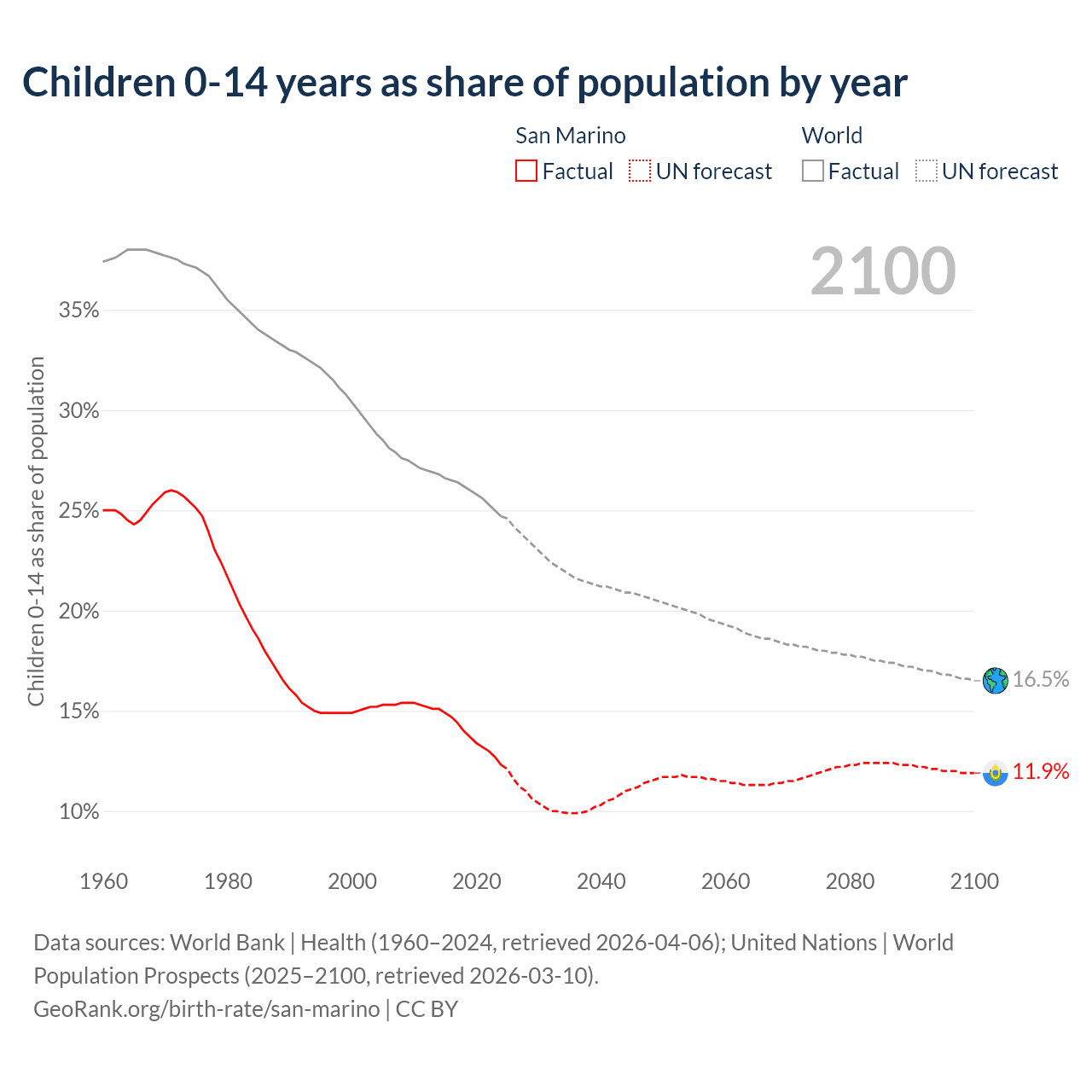
The share of children aged 0-14 in San Marino was 25% in 1960, 15.2% in 1993, and 11.9% as of the latest data in 2025.
More about the demographics of San Marino.
Fertility rates around the globe

Data sources: World Bank | Health (1960–2024, retrieved 2026-07-08).
GeoRank.org/birth-rate/san-marino | CC BY
Maternal mortality by year
| Year | Maternal mortality per 100K births | |
|---|---|---|
|
San Marino
|
World
|
|
| 2023 | 8 | 197 |
| 2022 | 22 | 203 |
| 2021 | 35 | 242 |
| 2020 | 46 | 211 |
| 2019 | 7 | 207 |
| 2018 | 7 | 211 |
| 2017 | 7 | 215 |
| 2016 | 7 | 220 |
| 2015 | 8 | 228 |
| 2014 | 8 | 231 |
| 2013 | 8 | 235 |
| 2012 | 8 | 239 |
| 2011 | 8 | 247 |
| 2010 | 8 | 253 |
| 2009 | 8 | 258 |
| 2008 | 8 | 264 |
| 2007 | 8 | 269 |
| 2006 | 12 | 276 |
| 2005 | 12 | 283 |
| 2004 | 13 | 291 |
| 2003 | 13 | 301 |
| 2002 | 14 | 311 |
| 2001 | 14 | 321 |
| 2000 | 14 | 328 |
| 1999 | 9 | 340 |
| 1998 | 9 | 360 |
| 1997 | 10 | 358 |
| 1996 | 10 | 366 |
| 1995 | 10 | 371 |
| 1994 | 10 | 382 |
| 1993 | 11 | 389 |
| 1992 | 11 | 395 |
| 1991 | 11 | 395 |
| 1990 | 11 | 391 |
| 1989 | 12 | 401 |
| 1988 | 12 | 414 |
| 1987 | 12 | 429 |
| 1986 | 12 | 438 |
| 1985 | 12 | 460 |
Data sources: World Bank | Gender (1985–2023, retrieved 2026-07-08).
GeoRank.org/birth-rate/san-marino | CC BY
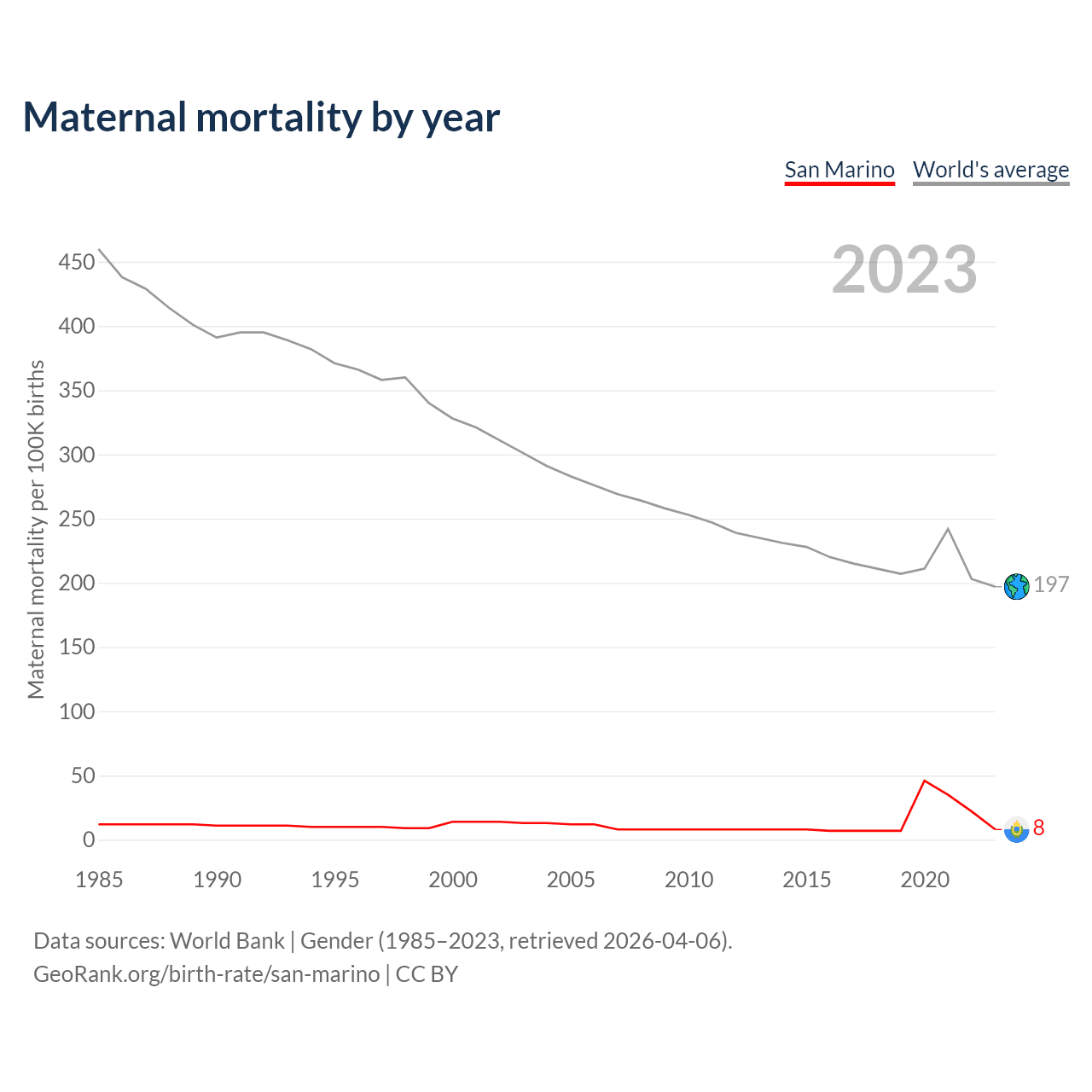
The maternal mortality rate in San Marino was 8 deaths per 100,000 live births in 2023 — a 0.008% chance of dying during childbirth or within 42 days of pregnancy termination. This is a 42.9% decrease compared to the year 2000.
Under-five mortality by year
Probability that a newborn baby will die before reaching age five
| Year | Under 5 mortality rate | |
|---|---|---|
|
San Marino
|
World
|
|
| 2024 | 0.13% | 2.49% |
| 2023 | 0.13% | 2.58% |
| 2022 | 0.14% | 2.7% |
| 2021 | 0.14% | 2.75% |
| 2020 | 0.15% | 2.79% |
| 2019 | 0.15% | 2.89% |
| 2018 | 0.16% | 2.98% |
| 2017 | 0.17% | 3.11% |
| 2016 | 0.18% | 3.21% |
| 2015 | 0.19% | 3.32% |
| 2014 | 0.2% | 3.44% |
| 2013 | 0.21% | 3.56% |
| 2012 | 0.23% | 3.72% |
| 2011 | 0.24% | 3.92% |
| 2010 | 0.26% | 4.06% |
| 2009 | 0.27% | 4.26% |
| 2008 | 0.29% | 4.45% |
| 2007 | 0.31% | 4.65% |
| 2006 | 0.33% | 4.87% |
| 2005 | 0.36% | 5.12% |
| 2004 | 0.38% | 5.44% |
| 2003 | 0.41% | 5.67% |
| 2002 | 0.45% | 5.96% |
| 2001 | 0.48% | 6.26% |
| 2000 | 0.52% | 6.52% |
| 1999 | 0.57% | 6.8% |
| 1998 | 0.62% | 7.13% |
| 1997 | 0.68% | 7.34% |
| 1996 | 0.74% | 7.6% |
| 1995 | 0.81% | 7.77% |
| 1994 | 0.88% | 8% |
| 1993 | 0.97% | 8.26% |
| 1992 | 1.06% | 8.47% |
| 1991 | 1.16% | 8.67% |
| 1990 | 1.27% | 8.84% |
| 1989 | 1.39% | 9.06% |
| 1988 | 1.52% | 9.44% |
| 1987 | 1.68% | 9.51% |
| 1986 | 1.84% | 9.86% |
| 1985 | 2.02% | 10.2% |
| 1984 | - | 10.4% |
| 1983 | - | 10.7% |
| 1982 | - | 10.9% |
| 1981 | - | 11.2% |
| 1980 | - | 11.5% |
| 1979 | - | 11.8% |
| 1978 | - | 12.3% |
| 1977 | - | 12.6% |
| 1976 | - | 13.1% |
| 1975 | - | 13.6% |
| 1974 | - | 13.9% |
| 1973 | - | 14.2% |
| 1972 | - | 14.6% |
| 1971 | - | 15.1% |
| 1970 | - | 15.6% |
| 1969 | - | 15.8% |
| 1968 | - | 16% |
| 1967 | - | 15.9% |
| 1966 | - | 16.2% |
| 1965 | - | 16.5% |
| 1964 | - | 16.6% |
| 1963 | - | 16.5% |
| 1962 | - | 16.7% |
| 1961 | - | 17% |
| 1960 | - | 17.3% |
Data sources: World Bank | Health (1960–2024, retrieved 2026-07-08).
GeoRank.org/birth-rate/san-marino | CC BY
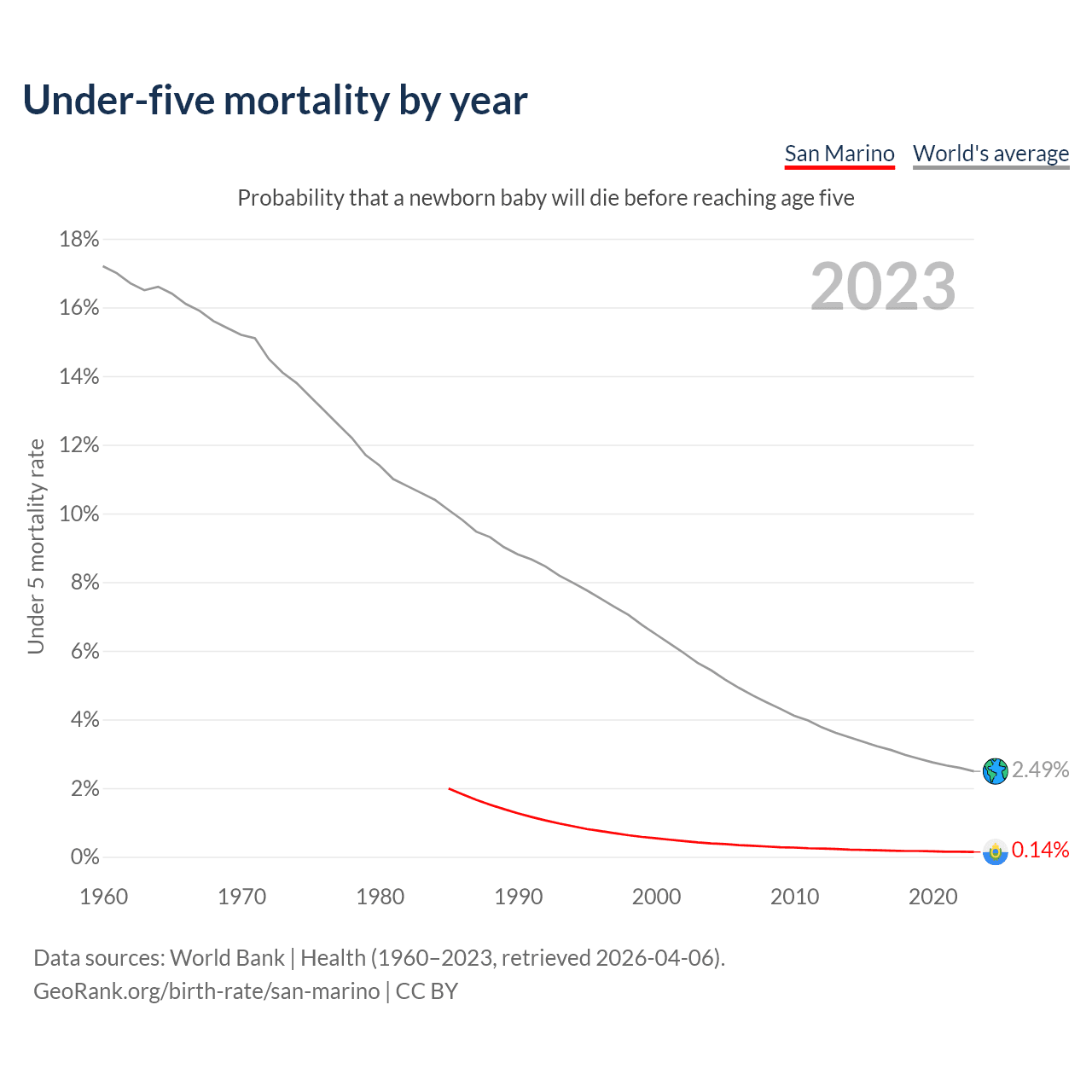
The under-5 mortality rate in San Marino was 1.3 deaths per 1,000 live births in 2024 — a 0.13% chance that a newborn baby will die before reaching age five. This is down from 5.2 deaths per 1,000 live births in 2000.
Compare countries by 7 more topics
Help us show the world through your eyes
Share a photo of your city and help others discover what it looks like to live there. Your contribution makes our data come alive.
Data sources:
- World Bank | Health (1960–2025, retrieved 2026-07-08)
- United Nations | World Population Prospects (1960–2100, retrieved 2026-07-08)
- United Nations Economic Commission for Europe (UNECE) (2001–2022, retrieved 2026-07-08)
Creative Commons Attribution (CC BY) — you’re free to copy, share, remix, adapt, and use even commercially as long as you give appropriate credit and clearly indicate if you made changes. Other sources may be subject to different license terms.
Fertility rate estimates the average number of children a woman would have over her lifetime based on a snapshot of current year age-specific birth patterns.
Birth rate represents the number of live births per 1,000 people in a population during a given year. Unlike the fertility rate, it does not account for age or sex composition of the population.