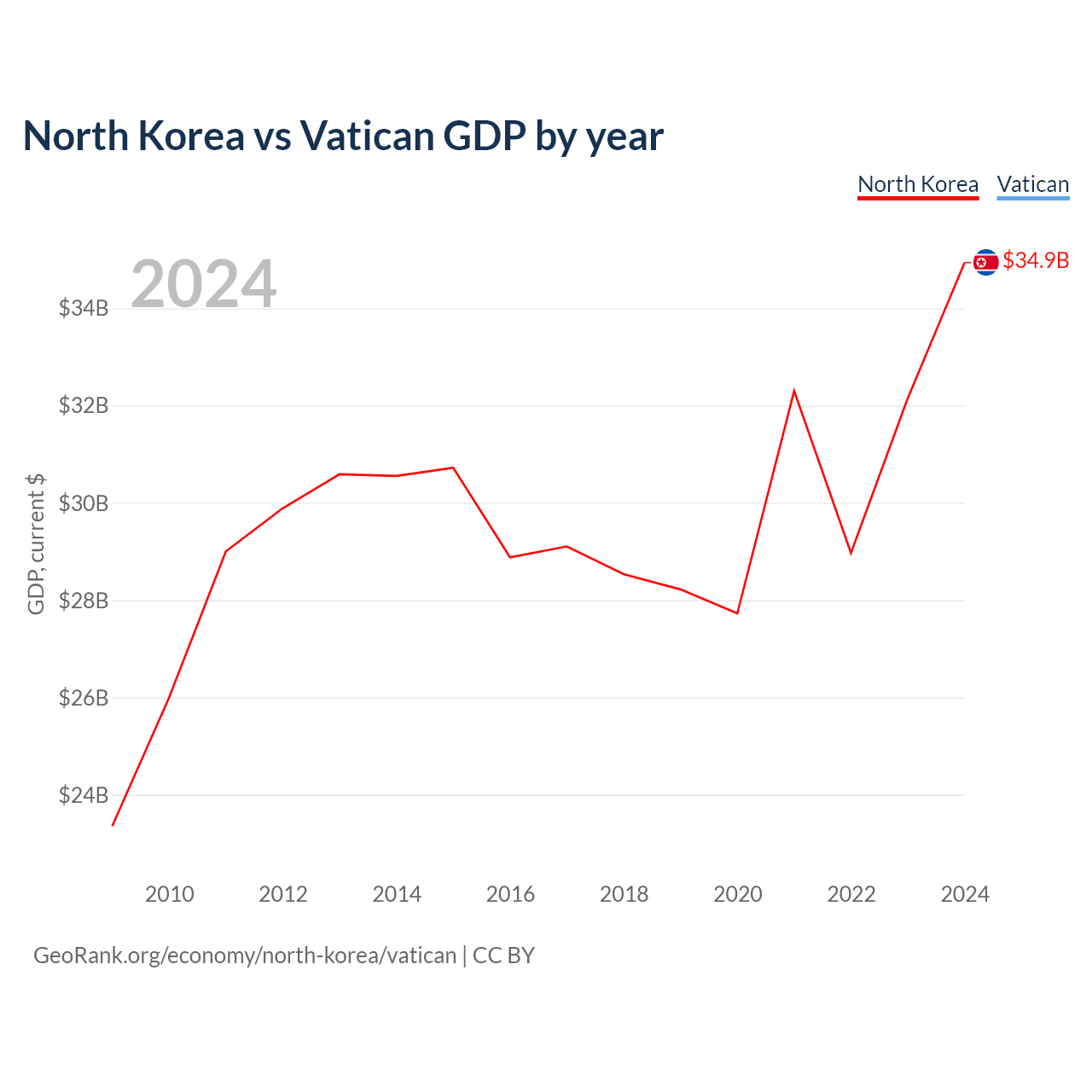
North Korea has a GDP of $34.9B compared to $19.8M for the Vatican, ranking 109/197 and 197/197 by economy size, respectively.
North Korea vs Vatican GDP by year
| Year | GDP, current $ | |
|---|---|---|
 North Korea
|
 Vatican
|
|
| 2024 | $34,943,120,000 | - |
| 2023 | $32,155,360,000 | - |
| 2022 | $28,971,360,000 | - |
| 2021 | $32,301,720,000 | - |
| 2020 | $27,728,240,000 | - |
| 2019 | $28,222,880,000 | - |
| 2018 | $28,536,400,000 | - |
| 2017 | $29,105,440,000 | - |
| 2016 | $28,882,640,000 | - |
| 2015 | $30,723,030,000 | - |
| 2014 | $30,554,460,000 | - |
| 2013 | $30,588,922,000 | - |
| 2012 | $29,890,710,000 | - |
| 2011 | $29,005,020,000 | - |
| 2010 | $25,995,513,000 | - |
| 2009 | $23,356,470,000 | - |
GeoRank.org/economy/north-korea/vatican | CC BY 
Economic indicators
|
North Korea
|
Vatican
|
|
|---|---|---|
| Gross domestic product |
$34.9B
2024 |
$19.8M
2026 |
| GDP rank |
109/197
2024 |
197/197
2026 |
| GDP per capita |
$1,319
2024 |
$19,800
2026 |
| GDP per capita rank |
169/197
2024 |
61/197
2026 |
| GDP per capita, PPP |
$1,700
2015 |
$39,191
2026 |
| GDP per capita PPP rank |
193/197
2015 |
59/197
2026 |
| Average annual personal income after taxes |
$1,707
2026 |
$18,688
2026 |
| Unemployment rate |
25.6%
2013 |
n/a |
| Population |
26668308
|
939
|
Economic freedom indices
The indices of economic freedom below are issued by the Heritage Foundation. Higher scores indicate stronger economic health.
|
North Korea
|
Vatican
|
|
|---|---|---|
| Economic freedom | 3.1 | 65 |
| Economic freedom ranking | 197/197 | 69/197 |
| Property rights | 16.3 | n/a |
| Government integrity | 4.3 | n/a |
| Judicial effectiveness | 6.3 | n/a |
| Tax burden | 0 | n/a |
| Government spending | 0 | n/a |
| Fiscal health | 0 | n/a |
| Business freedom | 5 | n/a |
| Labor freedom | 5 | n/a |
| Monetary freedom | 0 | n/a |
| Trade freedom | 0 | n/a |
| Investment freedom | 0 | n/a |
| Financial freedom | 0 | n/a |
Other economic metrics
|
North Korea
|
Vatican
|
|
|---|---|---|
|
Net inflows of foreign direct investment
|
$203K
1989 |
n/a |
|
Net outflows of foreign direct investment
|
$0
2024 |
n/a |
GDP per capita map
Data sources: World Bank | Economy & Growth (1985–2025, retrieved 2026-07-08); U.S. Census Bureau (1985–2025, retrieved 2026-07-08).
GeoRank.org/economy/north-korea/vatican | CC BY
Compare countries by 7 more topics
Help us show the world through your eyes
Share a photo of your city and help others discover what it looks like to live there. Your contribution makes our data come alive.
Data sources:
- World Bank | Economy & Growth (1985–2025, retrieved 2026-07-08)
- U.S. Census Bureau (1985–2025, retrieved 2026-07-08)
- The Heritage Foundation | Economic Freedom Index (2026, retrieved 2026-07-08)
- Central Intelligence Agency (CIA) (2013–2026, retrieved 2026-07-08)
- United Nations | World Population Prospects (2026, retrieved 2026-07-08)
- LivingCost (2026, retrieved 2026-07-08)
Creative Commons Attribution (CC BY) — you’re free to copy, share, remix, adapt, and use even commercially as long as you give appropriate credit and clearly indicate if you made changes. Other sources may be subject to different license terms.
Foreign direct investment (FDI, net inflows) shows how much capital foreign investors bring into a country after accounting for any funds that flow back in the opposite direction. It represents the net value of overseas companies establishing, expanding, or financing businesses in the reporting country. A positive number means more capital entered the country than was withdrawn, while a negative number means foreign investors pulled out more than they invested.
Foreign direct investment (FDI, net outflows) shows how much capital residents of a country invest abroad after accounting for any funds that flow back in the opposite direction. It represents the net value of domestic companies establishing, expanding, or financing businesses in other countries. A positive number means more capital was invested abroad than withdrawn, while a negative number means residents pulled back more than they invested.