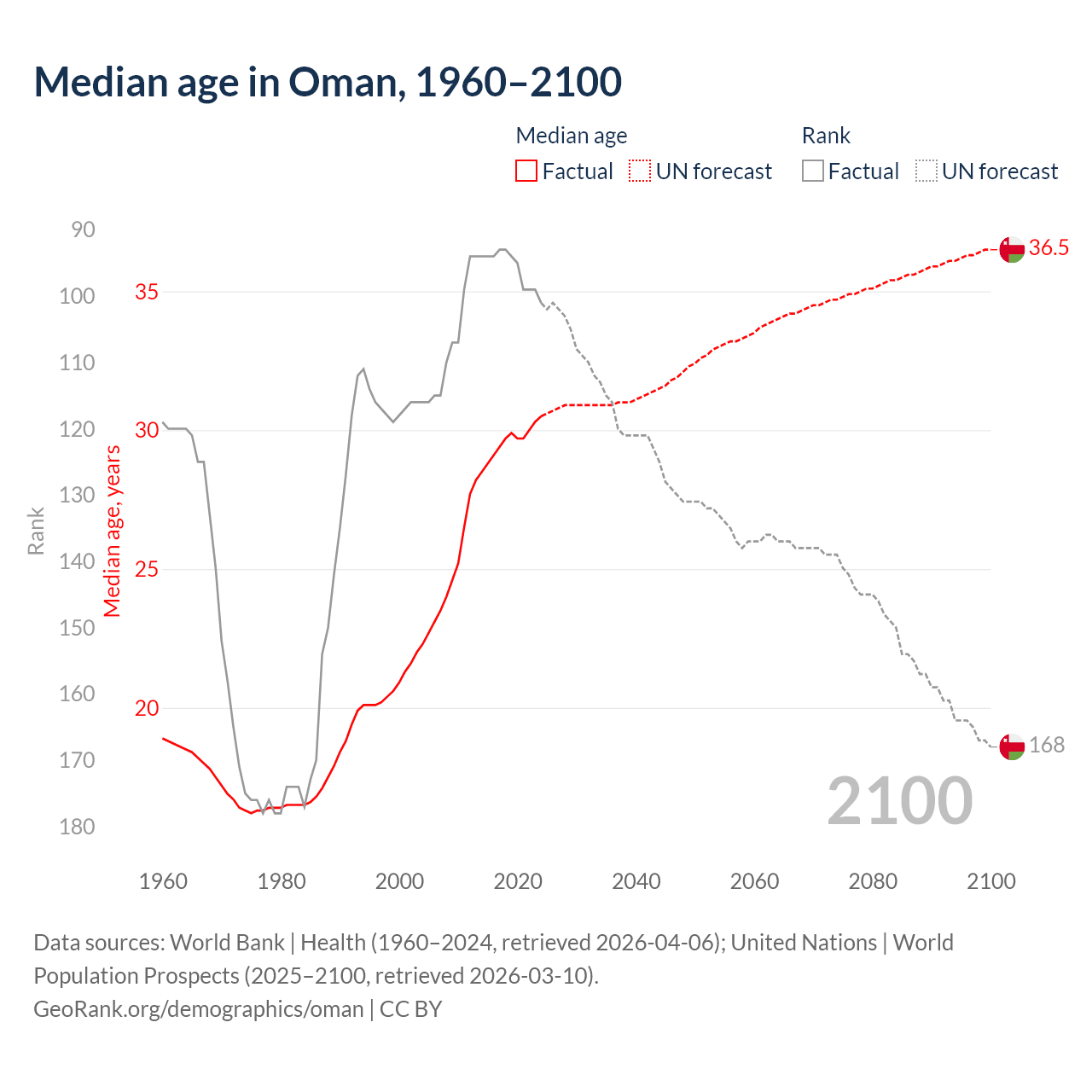
With a population of 5.49M people, Oman has a median age of 30.6 years which makes it the 99/196 oldest country. 24.3% of the demographic are children 0-14 years old, 73% are working-age people aged 15-64, and 2.69% are older population aged 65+ years.
Median age in Oman, 1960–2100
| Year | Median age, years | Rank |
|---|---|---|
| 2100 | 36.5 | 168 |
| 2099 | 36.5 | 167 |
| 2098 | 36.4 | 167 |
| 2097 | 36.3 | 165 |
| 2096 | 36.3 | 164 |
| 2095 | 36.2 | 164 |
| 2094 | 36.1 | 164 |
| 2093 | 36.1 | 161 |
| 2092 | 36 | 161 |
| 2091 | 35.9 | 159 |
| 2090 | 35.9 | 159 |
| 2089 | 35.8 | 157 |
| 2088 | 35.7 | 157 |
| 2087 | 35.6 | 155 |
| 2086 | 35.6 | 154 |
| 2085 | 35.5 | 154 |
| 2084 | 35.4 | 150 |
| 2083 | 35.4 | 149 |
| 2082 | 35.3 | 148 |
| 2081 | 35.2 | 146 |
| 2080 | 35.1 | 145 |
| 2079 | 35.1 | 145 |
| 2078 | 35 | 145 |
| 2077 | 34.9 | 144 |
| 2076 | 34.9 | 142 |
| 2075 | 34.8 | 141 |
| 2074 | 34.7 | 139 |
| 2073 | 34.7 | 139 |
| 2072 | 34.6 | 139 |
| 2071 | 34.5 | 138 |
| 2070 | 34.5 | 138 |
| 2069 | 34.4 | 138 |
| 2068 | 34.3 | 138 |
| 2067 | 34.2 | 138 |
| 2066 | 34.2 | 137 |
| 2065 | 34.1 | 137 |
| 2064 | 34 | 137 |
| 2063 | 33.9 | 136 |
| 2062 | 33.8 | 136 |
| 2061 | 33.7 | 137 |
| 2060 | 33.5 | 137 |
| 2059 | 33.4 | 137 |
| 2058 | 33.3 | 138 |
| 2057 | 33.2 | 137 |
| 2056 | 33.2 | 135 |
| 2055 | 33.1 | 134 |
| 2054 | 33 | 133 |
| 2053 | 32.9 | 132 |
| 2052 | 32.7 | 132 |
| 2051 | 32.6 | 131 |
| 2050 | 32.4 | 131 |
| 2049 | 32.3 | 131 |
| 2048 | 32.1 | 131 |
| 2047 | 31.9 | 130 |
| 2046 | 31.8 | 129 |
| 2045 | 31.6 | 128 |
| 2044 | 31.5 | 125 |
| 2043 | 31.4 | 123 |
| 2042 | 31.3 | 121 |
| 2041 | 31.2 | 121 |
| 2040 | 31.1 | 121 |
| 2039 | 31 | 121 |
| 2038 | 31 | 121 |
| 2037 | 31 | 120 |
| 2036 | 30.9 | 116 |
| 2035 | 30.9 | 115 |
| 2034 | 30.9 | 113 |
| 2033 | 30.9 | 112 |
| 2032 | 30.9 | 110 |
| 2031 | 30.9 | 109 |
| 2030 | 30.9 | 108 |
| 2029 | 30.9 | 105 |
| 2028 | 30.9 | 103 |
| 2027 | 30.8 | 102 |
| 2026 | 30.7 | 101 |
| 2025 | 30.6 | 99 |
| 2024 | 30.5 | 101 |
| 2023 | 30.3 | 99 |
| 2022 | 30 | 99 |
| 2021 | 29.7 | 99 |
| 2020 | 29.7 | 95 |
| 2019 | 29.9 | 94 |
| 2018 | 29.7 | 93 |
| 2017 | 29.4 | 93 |
| 2016 | 29.1 | 94 |
| 2015 | 28.8 | 94 |
| 2014 | 28.5 | 94 |
| 2013 | 28.2 | 94 |
| 2012 | 27.7 | 94 |
| 2011 | 26.5 | 99 |
| 2010 | 25.2 | 107 |
| 2009 | 24.6 | 107 |
| 2008 | 24 | 110 |
| 2007 | 23.5 | 115 |
| 2006 | 23.1 | 115 |
| 2005 | 22.7 | 116 |
| 2004 | 22.3 | 116 |
| 2003 | 22 | 116 |
| 2002 | 21.6 | 116 |
| 2001 | 21.3 | 117 |
| 2000 | 20.9 | 118 |
| 1999 | 20.6 | 119 |
| 1998 | 20.4 | 118 |
| 1997 | 20.2 | 117 |
| 1996 | 20.1 | 116 |
| 1995 | 20.1 | 114 |
| 1994 | 20.1 | 111 |
| 1993 | 19.9 | 112 |
| 1992 | 19.4 | 118 |
| 1991 | 18.8 | 127 |
| 1990 | 18.4 | 135 |
| 1989 | 17.9 | 142 |
| 1988 | 17.5 | 150 |
| 1987 | 17.1 | 154 |
| 1986 | 16.8 | 169 |
| 1985 | 16.6 | 173 |
| 1984 | 16.5 | 177 |
| 1983 | 16.5 | 174 |
| 1982 | 16.5 | 174 |
| 1981 | 16.5 | 174 |
| 1980 | 16.4 | 178 |
| 1979 | 16.4 | 178 |
| 1978 | 16.4 | 176 |
| 1977 | 16.3 | 178 |
| 1976 | 16.3 | 176 |
| 1975 | 16.2 | 176 |
| 1974 | 16.3 | 175 |
| 1973 | 16.4 | 171 |
| 1972 | 16.7 | 165 |
| 1971 | 16.9 | 158 |
| 1970 | 17.2 | 152 |
| 1969 | 17.5 | 141 |
| 1968 | 17.8 | 133 |
| 1967 | 18 | 125 |
| 1966 | 18.2 | 125 |
| 1965 | 18.4 | 121 |
| 1964 | 18.5 | 120 |
| 1963 | 18.6 | 120 |
| 1962 | 18.7 | 120 |
| 1961 | 18.8 | 120 |
| 1960 | 18.9 | 119 |
Data sources: World Bank | Health (1960–2025, retrieved 2026-07-08); United Nations | World Population Prospects (2026–2100, retrieved 2026-07-08).
GeoRank.org/demographics/oman | CC BY 
In 1960, the median age in Oman was 18.9 years compared to the world's average of 22.5 years. As of 2025, the median age had increased to 30.6 years, compared with the average of 31.8 years in other countries. Ranked 119th for median age 65 years ago (old to young), Oman ranks 99th currently.
According to the United Nations projections, the median age in Oman is expected to increase to 36.5 years by 2100. The aging demographics forecast is based on previous years' birth rates and increasing life expectancy.
Oman demographic data
 Oman
Oman
|
Rank | |
|---|---|---|
| Population |
5775345
|
120/197 |
| Median age | 30.6 years | 99/196 |
| Average age | 29.8 years | 123/196 |
| Age dependency ratio | 37% | 186/196 |
| Young-age dependency ratio | 33.3% | 104/196 |
| Old-age dependency ratio | 3.68% | 193/196 |
| Male:Female ratio | 62.4:37.6 | N/A |
| Population density | 18.4 ppl/mi² | 176/197 |
| Fertility rate | 2.51 | 74/196 |
| Life expectancy | 80.7 years | 43/197 |
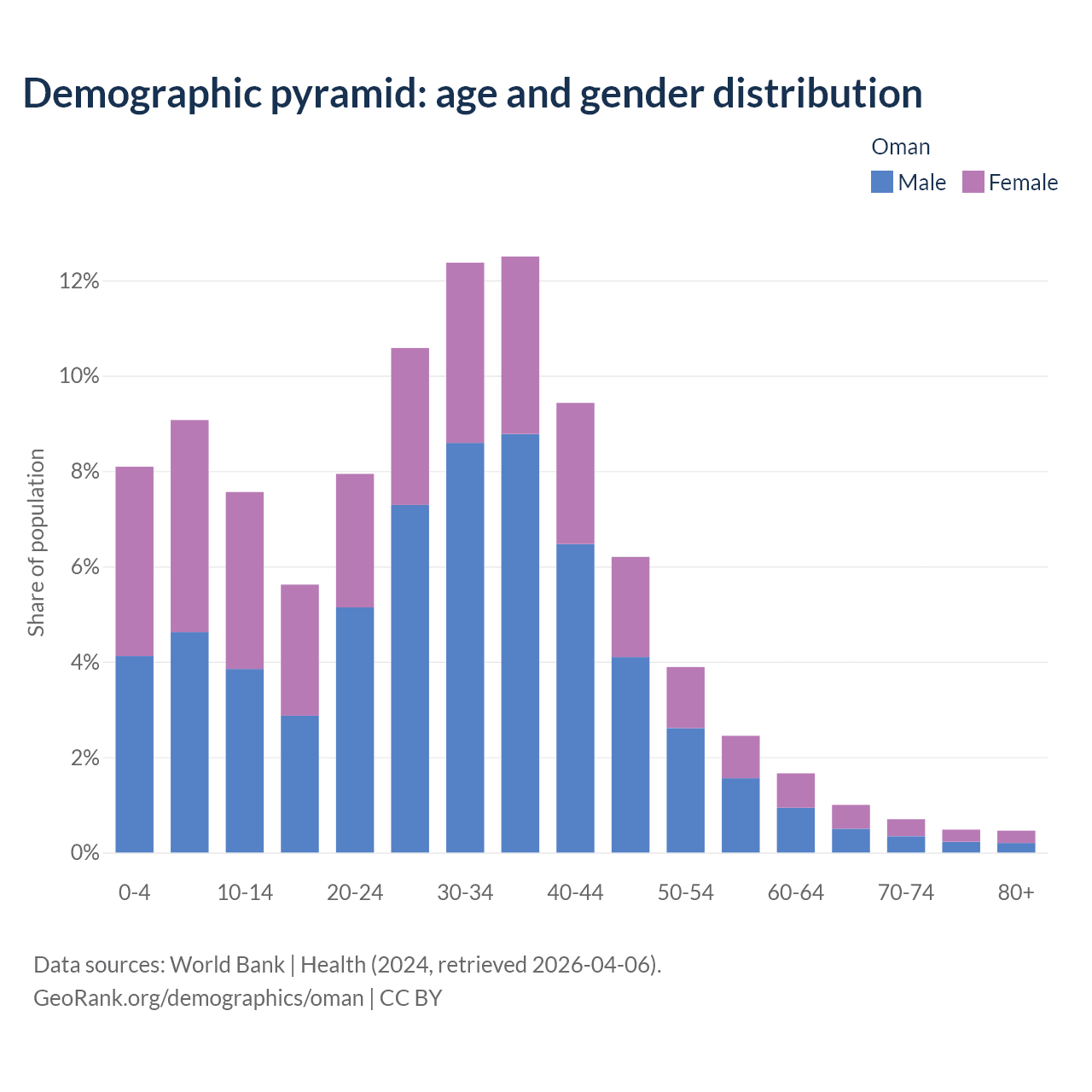
Demographic pyramid: age and gender distribution
| Age range | Share of population | |
|---|---|---|
|
Oman
|
||
| Male | Female | |
| 80+ | 0.2% | 0.26% |
| 75-79 | 0.23% | 0.25% |
| 70-74 | 0.33% | 0.36% |
| 65-69 | 0.53% | 0.53% |
| 60-64 | 0.94% | 0.71% |
| 55-59 | 1.57% | 0.89% |
| 50-54 | 2.68% | 1.33% |
| 45-49 | 4.19% | 2.16% |
| 40-44 | 6.58% | 3% |
| 35-39 | 8.84% | 3.7% |
| 30-34 | 8.61% | 3.72% |
| 25-29 | 7.25% | 3.2% |
| 20-24 | 5.13% | 2.76% |
| 15-19 | 2.94% | 2.82% |
| 10-14 | 3.91% | 3.75% |
| 5-9 | 4.45% | 4.29% |
| 0-4 | 4.04% | 3.88% |
Data sources: World Bank | Health (2025, retrieved 2026-07-08).
GeoRank.org/demographics/oman | CC BY
The chart above is a variation of the population pyramid and represents the age and gender structure. Oman has average demographic potential with 60.7% of people in the 0-34 age group (ranked 82/196).
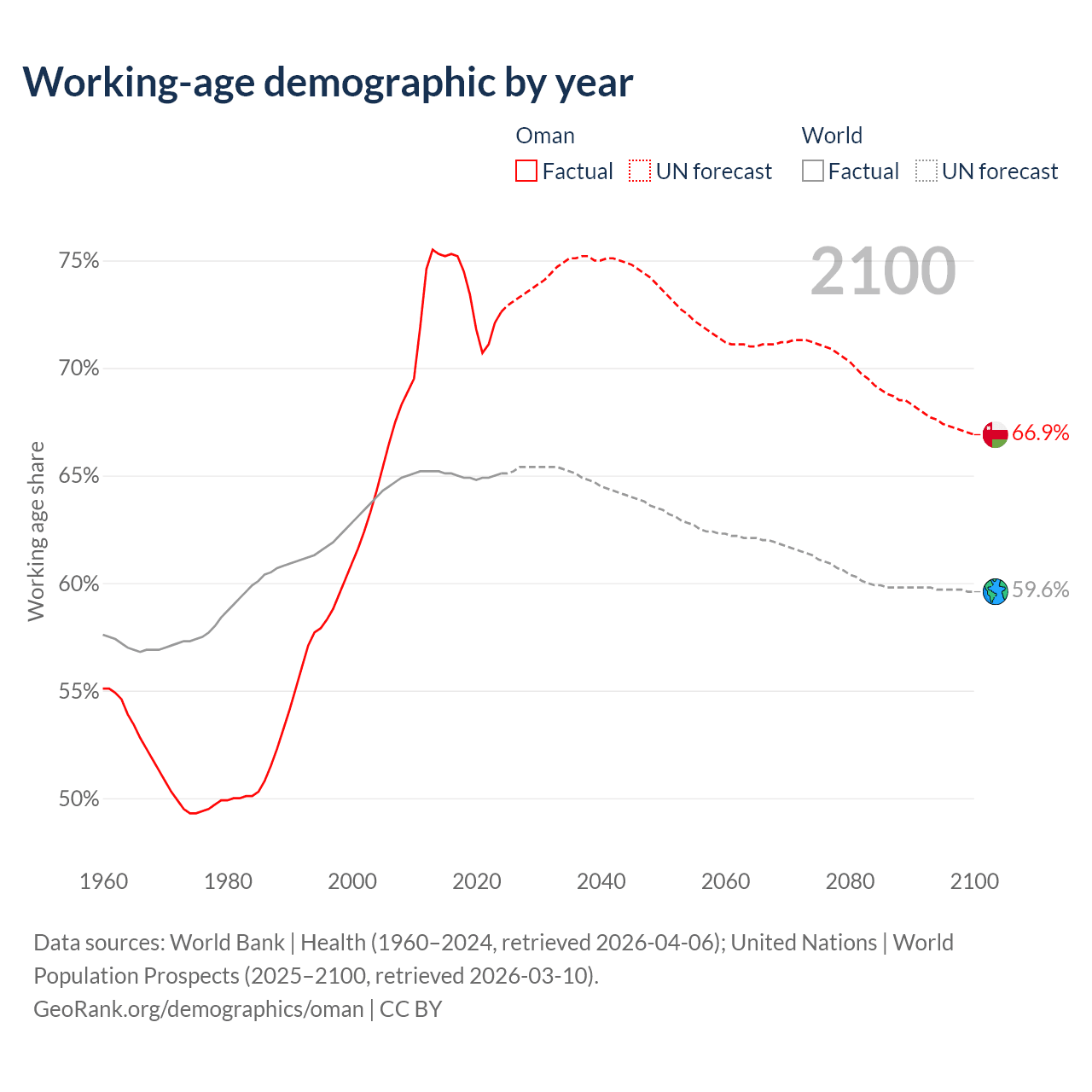
Working-age demographic by year
| Year | Working age share | |
|---|---|---|
|
Oman
|
 World
World
|
|
| 2100 | 66.9% | 59.6% |
| 2099 | 67% | 59.6% |
| 2098 | 67.1% | 59.7% |
| 2097 | 67.2% | 59.7% |
| 2096 | 67.3% | 59.7% |
| 2095 | 67.4% | 59.7% |
| 2094 | 67.6% | 59.7% |
| 2093 | 67.7% | 59.8% |
| 2092 | 67.9% | 59.8% |
| 2091 | 68.1% | 59.8% |
| 2090 | 68.3% | 59.8% |
| 2089 | 68.5% | 59.8% |
| 2088 | 68.5% | 59.8% |
| 2087 | 68.7% | 59.8% |
| 2086 | 68.8% | 59.8% |
| 2085 | 69% | 59.9% |
| 2084 | 69.2% | 59.9% |
| 2083 | 69.5% | 60% |
| 2082 | 69.7% | 60.1% |
| 2081 | 70% | 60.3% |
| 2080 | 70.3% | 60.4% |
| 2079 | 70.5% | 60.6% |
| 2078 | 70.7% | 60.7% |
| 2077 | 70.9% | 60.9% |
| 2076 | 71% | 61% |
| 2075 | 71.1% | 61.1% |
| 2074 | 71.2% | 61.3% |
| 2073 | 71.3% | 61.4% |
| 2072 | 71.3% | 61.5% |
| 2071 | 71.3% | 61.6% |
| 2070 | 71.2% | 61.7% |
| 2069 | 71.2% | 61.8% |
| 2068 | 71.1% | 61.9% |
| 2067 | 71.1% | 62% |
| 2066 | 71.1% | 62% |
| 2065 | 71% | 62.1% |
| 2064 | 71% | 62.1% |
| 2063 | 71.1% | 62.1% |
| 2062 | 71.1% | 62.2% |
| 2061 | 71.1% | 62.2% |
| 2060 | 71.2% | 62.3% |
| 2059 | 71.4% | 62.3% |
| 2058 | 71.6% | 62.4% |
| 2057 | 71.8% | 62.4% |
| 2056 | 72% | 62.5% |
| 2055 | 72.2% | 62.7% |
| 2054 | 72.5% | 62.8% |
| 2053 | 72.7% | 62.9% |
| 2052 | 73% | 63.1% |
| 2051 | 73.3% | 63.2% |
| 2050 | 73.6% | 63.4% |
| 2049 | 73.9% | 63.5% |
| 2048 | 74.2% | 63.6% |
| 2047 | 74.4% | 63.8% |
| 2046 | 74.6% | 63.9% |
| 2045 | 74.8% | 64% |
| 2044 | 74.9% | 64.1% |
| 2043 | 75% | 64.2% |
| 2042 | 75.1% | 64.3% |
| 2041 | 75.1% | 64.4% |
| 2040 | 75% | 64.5% |
| 2039 | 75% | 64.7% |
| 2038 | 75.2% | 64.8% |
| 2037 | 75.2% | 64.9% |
| 2036 | 75.1% | 65.1% |
| 2035 | 75.1% | 65.2% |
| 2034 | 74.9% | 65.3% |
| 2033 | 74.7% | 65.4% |
| 2032 | 74.4% | 65.4% |
| 2031 | 74.1% | 65.4% |
| 2030 | 73.9% | 65.4% |
| 2029 | 73.7% | 65.4% |
| 2028 | 73.5% | 65.4% |
| 2027 | 73.3% | 65.4% |
| 2026 | 73.1% | 65.2% |
| 2025 | 73% | 65.2% |
| 2024 | 72.6% | 65.1% |
| 2023 | 72.1% | 65% |
| 2022 | 71.1% | 64.9% |
| 2021 | 70.7% | 64.9% |
| 2020 | 71.8% | 64.8% |
| 2019 | 73.4% | 64.9% |
| 2018 | 74.5% | 64.9% |
| 2017 | 75.2% | 65% |
| 2016 | 75.3% | 65.1% |
| 2015 | 75.2% | 65.1% |
| 2014 | 75.3% | 65.2% |
| 2013 | 75.5% | 65.2% |
| 2012 | 74.6% | 65.2% |
| 2011 | 71.9% | 65.2% |
| 2010 | 69.5% | 65.1% |
| 2009 | 68.9% | 65% |
| 2008 | 68.3% | 64.9% |
| 2007 | 67.5% | 64.7% |
| 2006 | 66.5% | 64.5% |
| 2005 | 65.4% | 64.3% |
| 2004 | 64.3% | 64% |
| 2003 | 63.3% | 63.7% |
| 2002 | 62.4% | 63.4% |
| 2001 | 61.6% | 63.1% |
| 2000 | 60.9% | 62.8% |
| 1999 | 60.2% | 62.5% |
| 1998 | 59.5% | 62.2% |
| 1997 | 58.8% | 61.9% |
| 1996 | 58.3% | 61.7% |
| 1995 | 57.9% | 61.5% |
| 1994 | 57.7% | 61.3% |
| 1993 | 57.1% | 61.2% |
| 1992 | 56.1% | 61.1% |
| 1991 | 55.1% | 61% |
| 1990 | 54.1% | 60.9% |
| 1989 | 53.2% | 60.8% |
| 1988 | 52.3% | 60.7% |
| 1987 | 51.5% | 60.5% |
| 1986 | 50.8% | 60.4% |
| 1985 | 50.3% | 60.1% |
| 1984 | 50.1% | 59.9% |
| 1983 | 50.1% | 59.6% |
| 1982 | 50% | 59.3% |
| 1981 | 50% | 59% |
| 1980 | 49.9% | 58.7% |
| 1979 | 49.9% | 58.4% |
| 1978 | 49.7% | 58% |
| 1977 | 49.5% | 57.7% |
| 1976 | 49.4% | 57.5% |
| 1975 | 49.3% | 57.4% |
| 1974 | 49.3% | 57.3% |
| 1973 | 49.5% | 57.3% |
| 1972 | 49.9% | 57.2% |
| 1971 | 50.3% | 57.1% |
| 1970 | 50.8% | 57% |
| 1969 | 51.3% | 56.9% |
| 1968 | 51.8% | 56.9% |
| 1967 | 52.3% | 56.9% |
| 1966 | 52.8% | 56.8% |
| 1965 | 53.4% | 56.9% |
| 1964 | 53.9% | 57% |
| 1963 | 54.6% | 57.2% |
| 1962 | 54.9% | 57.4% |
| 1961 | 55.1% | 57.5% |
| 1960 | 55.1% | 57.6% |
Data sources: World Bank | Health (1960–2025, retrieved 2026-07-08); United Nations | World Population Prospects (2026–2100, retrieved 2026-07-08).
GeoRank.org/demographics/oman | CC BY
The share of working-age demographics aged 15-64 in Oman changed from 65.4% to 73% between 2005 and 2025.
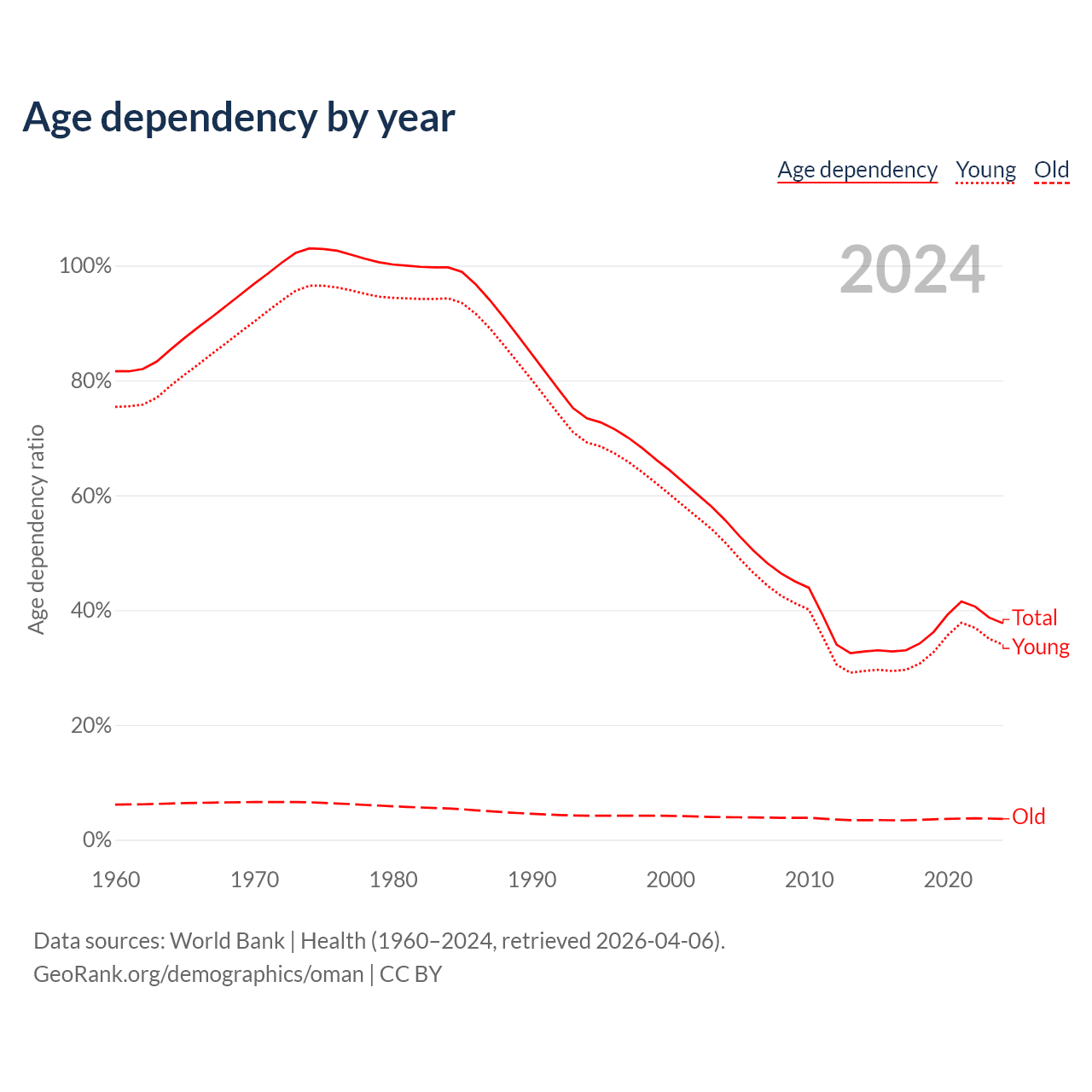
Age dependency by year
| Year | Age dependency ratio | ||
|---|---|---|---|
| Total | Young | Old | |
| 2025 | 37% | 33.3% | 3.68% |
| 2024 | 37.7% | 34% | 3.64% |
| 2023 | 38.7% | 35% | 3.69% |
| 2022 | 40.6% | 36.9% | 3.74% |
| 2021 | 41.5% | 37.8% | 3.7% |
| 2020 | 39.2% | 35.6% | 3.63% |
| 2019 | 36.2% | 32.7% | 3.56% |
| 2018 | 34.2% | 30.7% | 3.47% |
| 2017 | 33% | 29.6% | 3.39% |
| 2016 | 32.8% | 29.4% | 3.39% |
| 2015 | 33% | 29.6% | 3.43% |
| 2014 | 32.8% | 29.4% | 3.41% |
| 2013 | 32.5% | 29.1% | 3.41% |
| 2012 | 34% | 30.5% | 3.52% |
| 2011 | 39.1% | 35.4% | 3.68% |
| 2010 | 43.9% | 40.1% | 3.82% |
| 2009 | 45% | 41.2% | 3.83% |
| 2008 | 46.4% | 42.5% | 3.83% |
| 2007 | 48.2% | 44.3% | 3.86% |
| 2006 | 50.4% | 46.5% | 3.89% |
| 2005 | 52.9% | 49% | 3.91% |
| 2004 | 55.6% | 51.7% | 3.93% |
| 2003 | 58% | 54.1% | 3.97% |
| 2002 | 60.1% | 56.1% | 4.05% |
| 2001 | 62.2% | 58.1% | 4.12% |
| 2000 | 64.3% | 60.1% | 4.16% |
| 1999 | 66.2% | 62.1% | 4.19% |
| 1998 | 68.2% | 64% | 4.2% |
| 1997 | 70% | 65.8% | 4.2% |
| 1996 | 71.5% | 67.3% | 4.2% |
| 1995 | 72.7% | 68.5% | 4.2% |
| 1994 | 73.4% | 69.2% | 4.2% |
| 1993 | 75.2% | 71% | 4.23% |
| 1992 | 78.3% | 74% | 4.31% |
| 1991 | 81.5% | 77.1% | 4.42% |
| 1990 | 84.7% | 80.2% | 4.53% |
| 1989 | 87.9% | 83.2% | 4.66% |
| 1988 | 91% | 86.2% | 4.8% |
| 1987 | 94% | 89.1% | 4.96% |
| 1986 | 96.7% | 91.6% | 5.13% |
| 1985 | 98.9% | 93.5% | 5.32% |
| 1984 | 99.7% | 94.3% | 5.45% |
| 1983 | 99.7% | 94.2% | 5.53% |
| 1982 | 99.8% | 94.2% | 5.62% |
| 1981 | 100% | 94.3% | 5.72% |
| 1980 | 100.2% | 94.4% | 5.83% |
| 1979 | 100.6% | 94.6% | 5.95% |
| 1978 | 101.2% | 95.1% | 6.07% |
| 1977 | 101.9% | 95.7% | 6.2% |
| 1976 | 102.6% | 96.2% | 6.32% |
| 1975 | 102.9% | 96.5% | 6.43% |
| 1974 | 103% | 96.5% | 6.53% |
| 1973 | 102.2% | 95.6% | 6.58% |
| 1972 | 100.5% | 93.9% | 6.58% |
| 1971 | 98.6% | 92.1% | 6.57% |
| 1970 | 96.8% | 90.2% | 6.56% |
| 1969 | 94.9% | 88.4% | 6.54% |
| 1968 | 93% | 86.5% | 6.51% |
| 1967 | 91.1% | 84.7% | 6.47% |
| 1966 | 89.3% | 82.8% | 6.43% |
| 1965 | 87.4% | 81% | 6.38% |
| 1964 | 85.4% | 79.1% | 6.32% |
| 1963 | 83.3% | 77% | 6.24% |
| 1962 | 82% | 75.8% | 6.18% |
| 1961 | 81.6% | 75.5% | 6.15% |
| 1960 | 81.6% | 75.4% | 6.13% |
Data sources: World Bank | Health (1960–2025, retrieved 2026-07-08).
GeoRank.org/demographics/oman | CC BY
Age dependency is the ratio of people not in the labor force (children under 15 and adults 64+) to people aged 15 to 64. Age dependency in Oman decreased from 52.9% to 37% between 2005 and 2025 with a decreased share of children and an increased proportion of people aged 65+
Share of young demographic (0-14 years) by year
| Year | Share of 0-14 | |
|---|---|---|
|
Oman
|
World
|
|
| 2100 | 17.2% | 16.5% |
| 2099 | 17.2% | 16.6% |
| 2098 | 17.3% | 16.6% |
| 2097 | 17.3% | 16.7% |
| 2096 | 17.4% | 16.8% |
| 2095 | 17.4% | 16.8% |
| 2094 | 17.4% | 16.9% |
| 2093 | 17.5% | 17% |
| 2092 | 17.5% | 17% |
| 2091 | 17.5% | 17.1% |
| 2090 | 17.6% | 17.2% |
| 2089 | 17.6% | 17.2% |
| 2088 | 17.6% | 17.3% |
| 2087 | 17.6% | 17.4% |
| 2086 | 17.6% | 17.4% |
| 2085 | 17.7% | 17.5% |
| 2084 | 17.7% | 17.5% |
| 2083 | 17.7% | 17.6% |
| 2082 | 17.7% | 17.7% |
| 2081 | 17.8% | 17.7% |
| 2080 | 17.8% | 17.8% |
| 2079 | 17.8% | 17.8% |
| 2078 | 17.9% | 17.9% |
| 2077 | 17.9% | 17.9% |
| 2076 | 18% | 18% |
| 2075 | 18.1% | 18% |
| 2074 | 18.1% | 18.1% |
| 2073 | 18.2% | 18.2% |
| 2072 | 18.3% | 18.2% |
| 2071 | 18.4% | 18.3% |
| 2070 | 18.5% | 18.3% |
| 2069 | 18.6% | 18.4% |
| 2068 | 18.7% | 18.5% |
| 2067 | 18.8% | 18.6% |
| 2066 | 18.9% | 18.6% |
| 2065 | 19.1% | 18.7% |
| 2064 | 19.2% | 18.8% |
| 2063 | 19.3% | 18.9% |
| 2062 | 19.4% | 19.1% |
| 2061 | 19.5% | 19.2% |
| 2060 | 19.6% | 19.3% |
| 2059 | 19.7% | 19.4% |
| 2058 | 19.7% | 19.5% |
| 2057 | 19.8% | 19.6% |
| 2056 | 19.9% | 19.8% |
| 2055 | 19.9% | 19.9% |
| 2054 | 19.9% | 20% |
| 2053 | 20% | 20.1% |
| 2052 | 20% | 20.2% |
| 2051 | 20% | 20.3% |
| 2050 | 20% | 20.4% |
| 2049 | 20% | 20.5% |
| 2048 | 20.1% | 20.6% |
| 2047 | 20.1% | 20.7% |
| 2046 | 20.2% | 20.8% |
| 2045 | 20.3% | 20.9% |
| 2044 | 20.4% | 20.9% |
| 2043 | 20.6% | 21% |
| 2042 | 20.7% | 21.1% |
| 2041 | 20.9% | 21.2% |
| 2040 | 21.1% | 21.2% |
| 2039 | 21.3% | 21.3% |
| 2038 | 21.3% | 21.4% |
| 2037 | 21.4% | 21.5% |
| 2036 | 21.5% | 21.6% |
| 2035 | 21.7% | 21.8% |
| 2034 | 22% | 22% |
| 2033 | 22.2% | 22.2% |
| 2032 | 22.6% | 22.4% |
| 2031 | 22.9% | 22.7% |
| 2030 | 23.2% | 23% |
| 2029 | 23.5% | 23.3% |
| 2028 | 23.7% | 23.6% |
| 2027 | 23.9% | 23.9% |
| 2026 | 24.2% | 24.2% |
| 2025 | 24.3% | 24.4% |
| 2024 | 24.7% | 24.7% |
| 2023 | 25.2% | 25% |
| 2022 | 26.2% | 25.3% |
| 2021 | 26.7% | 25.6% |
| 2020 | 25.6% | 25.8% |
| 2019 | 24% | 26% |
| 2018 | 22.9% | 26.2% |
| 2017 | 22.3% | 26.4% |
| 2016 | 22.1% | 26.5% |
| 2015 | 22.2% | 26.6% |
| 2014 | 22.1% | 26.8% |
| 2013 | 21.9% | 26.9% |
| 2012 | 22.8% | 27% |
| 2011 | 25.5% | 27.1% |
| 2010 | 27.9% | 27.3% |
| 2009 | 28.4% | 27.5% |
| 2008 | 29.1% | 27.6% |
| 2007 | 29.9% | 27.9% |
| 2006 | 30.9% | 28.1% |
| 2005 | 32.1% | 28.5% |
| 2004 | 33.2% | 28.8% |
| 2003 | 34.2% | 29.2% |
| 2002 | 35% | 29.6% |
| 2001 | 35.8% | 30% |
| 2000 | 36.6% | 30.4% |
| 1999 | 37.3% | 30.8% |
| 1998 | 38% | 31.1% |
| 1997 | 38.7% | 31.5% |
| 1996 | 39.3% | 31.8% |
| 1995 | 39.7% | 32.1% |
| 1994 | 39.9% | 32.3% |
| 1993 | 40.5% | 32.5% |
| 1992 | 41.5% | 32.7% |
| 1991 | 42.5% | 32.9% |
| 1990 | 43.4% | 33% |
| 1989 | 44.3% | 33.2% |
| 1988 | 45.1% | 33.3% |
| 1987 | 45.9% | 33.6% |
| 1986 | 46.5% | 33.8% |
| 1985 | 47% | 34% |
| 1984 | 47.2% | 34.3% |
| 1983 | 47.2% | 34.6% |
| 1982 | 47.1% | 34.9% |
| 1981 | 47.1% | 35.2% |
| 1980 | 47.1% | 35.5% |
| 1979 | 47.2% | 35.8% |
| 1978 | 47.3% | 36.3% |
| 1977 | 47.4% | 36.7% |
| 1976 | 47.5% | 36.9% |
| 1975 | 47.5% | 37.1% |
| 1974 | 47.5% | 37.2% |
| 1973 | 47.3% | 37.3% |
| 1972 | 46.8% | 37.5% |
| 1971 | 46.4% | 37.6% |
| 1970 | 45.9% | 37.7% |
| 1969 | 45.3% | 37.8% |
| 1968 | 44.8% | 37.9% |
| 1967 | 44.3% | 38% |
| 1966 | 43.8% | 38% |
| 1965 | 43.2% | 38% |
| 1964 | 42.6% | 38% |
| 1963 | 42% | 37.8% |
| 1962 | 41.7% | 37.6% |
| 1961 | 41.6% | 37.5% |
| 1960 | 41.5% | 37.4% |
Data sources: World Bank | Health (1960–2025, retrieved 2026-07-08); United Nations | World Population Prospects (2026–2100, retrieved 2026-07-08).
GeoRank.org/demographics/oman | CC BY
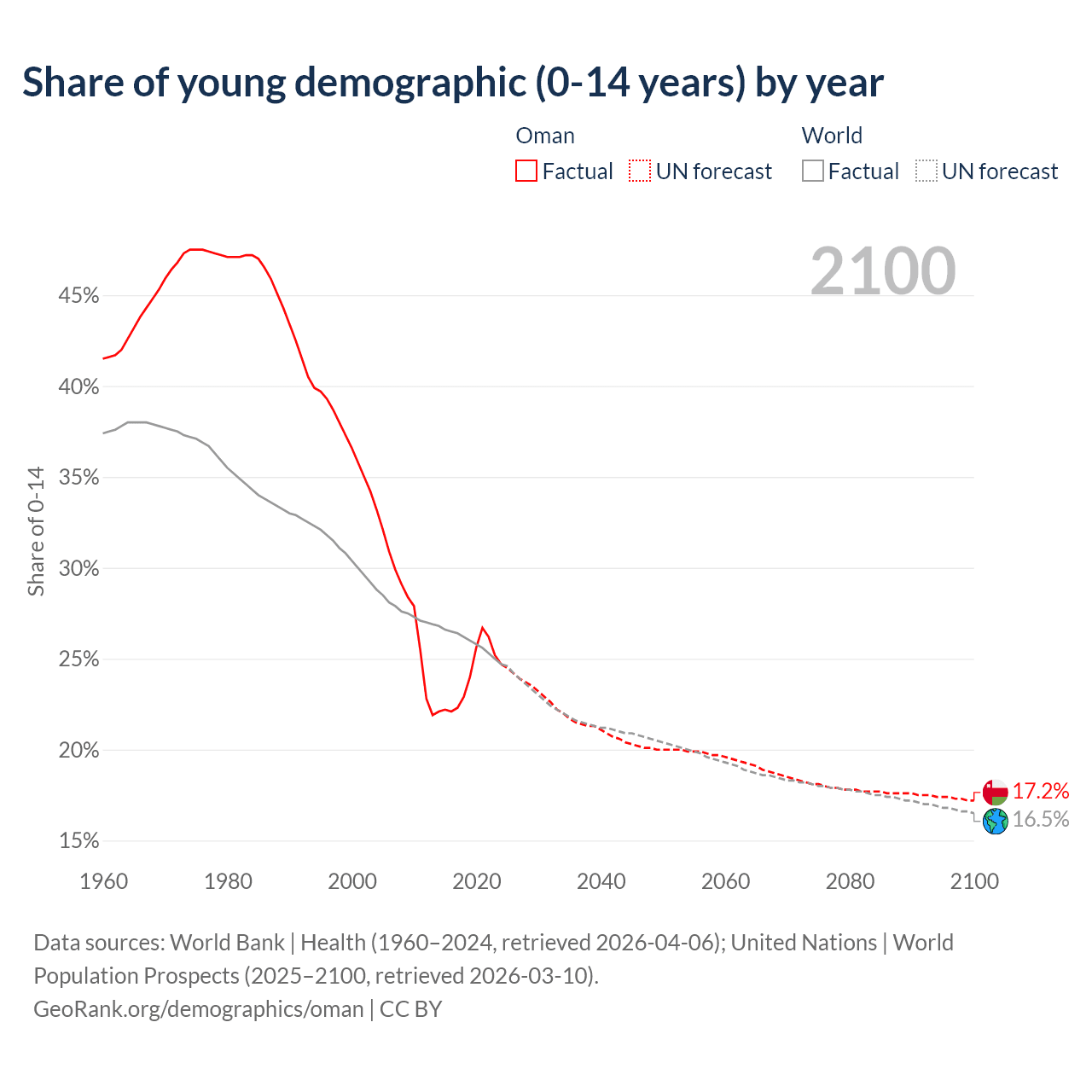
The share of children aged 0-14 in Oman decreased from 32.1% to 24.3% between 2005 and 2025 due to changes in birth rates.
Share of old population (65+) by year
| Year | Share of 65+ years old | |
|---|---|---|
|
Oman
|
World
|
|
| 2100 | 15.9% | 23.9% |
| 2099 | 15.8% | 23.8% |
| 2098 | 15.6% | 23.7% |
| 2097 | 15.5% | 23.6% |
| 2096 | 15.3% | 23.5% |
| 2095 | 15.2% | 23.4% |
| 2094 | 15% | 23.4% |
| 2093 | 14.8% | 23.3% |
| 2092 | 14.6% | 23.2% |
| 2091 | 14.4% | 23.1% |
| 2090 | 14.1% | 23.1% |
| 2089 | 13.9% | 23% |
| 2088 | 13.9% | 22.9% |
| 2087 | 13.7% | 22.8% |
| 2086 | 13.5% | 22.7% |
| 2085 | 13.3% | 22.6% |
| 2084 | 13.1% | 22.5% |
| 2083 | 12.8% | 22.4% |
| 2082 | 12.5% | 22.2% |
| 2081 | 12.2% | 22% |
| 2080 | 11.9% | 21.8% |
| 2079 | 11.7% | 21.6% |
| 2078 | 11.4% | 21.4% |
| 2077 | 11.2% | 21.2% |
| 2076 | 11% | 21% |
| 2075 | 10.8% | 20.8% |
| 2074 | 10.7% | 20.6% |
| 2073 | 10.5% | 20.4% |
| 2072 | 10.4% | 20.3% |
| 2071 | 10.4% | 20.1% |
| 2070 | 10.3% | 19.9% |
| 2069 | 10.2% | 19.8% |
| 2068 | 10.1% | 19.6% |
| 2067 | 10.1% | 19.5% |
| 2066 | 9.99% | 19.3% |
| 2065 | 9.9% | 19.2% |
| 2064 | 9.79% | 19.1% |
| 2063 | 9.67% | 18.9% |
| 2062 | 9.54% | 18.8% |
| 2061 | 9.38% | 18.6% |
| 2060 | 9.19% | 18.5% |
| 2059 | 8.96% | 18.3% |
| 2058 | 8.71% | 18.1% |
| 2057 | 8.44% | 17.9% |
| 2056 | 8.18% | 17.7% |
| 2055 | 7.89% | 17.5% |
| 2054 | 7.6% | 17.2% |
| 2053 | 7.3% | 17% |
| 2052 | 6.99% | 16.7% |
| 2051 | 6.67% | 16.4% |
| 2050 | 6.35% | 16.2% |
| 2049 | 6.04% | 16% |
| 2048 | 5.73% | 15.8% |
| 2047 | 5.44% | 15.5% |
| 2046 | 5.17% | 15.3% |
| 2045 | 4.91% | 15.1% |
| 2044 | 4.66% | 14.9% |
| 2043 | 4.42% | 14.8% |
| 2042 | 4.19% | 14.6% |
| 2041 | 3.99% | 14.4% |
| 2040 | 3.82% | 14.2% |
| 2039 | 3.66% | 14% |
| 2038 | 3.54% | 13.8% |
| 2037 | 3.43% | 13.5% |
| 2036 | 3.33% | 13.3% |
| 2035 | 3.23% | 13% |
| 2034 | 3.16% | 12.7% |
| 2033 | 3.09% | 12.4% |
| 2032 | 3.03% | 12.2% |
| 2031 | 2.98% | 11.9% |
| 2030 | 2.91% | 11.6% |
| 2029 | 2.85% | 11.3% |
| 2028 | 2.8% | 11% |
| 2027 | 2.74% | 10.7% |
| 2026 | 2.73% | 10.5% |
| 2025 | 2.69% | 10.4% |
| 2024 | 2.64% | 10.2% |
| 2023 | 2.66% | 9.98% |
| 2022 | 2.66% | 9.74% |
| 2021 | 2.62% | 9.53% |
| 2020 | 2.61% | 9.33% |
| 2019 | 2.61% | 9.11% |
| 2018 | 2.58% | 8.88% |
| 2017 | 2.55% | 8.66% |
| 2016 | 2.55% | 8.45% |
| 2015 | 2.57% | 8.26% |
| 2014 | 2.56% | 8.08% |
| 2013 | 2.58% | 7.92% |
| 2012 | 2.63% | 7.78% |
| 2011 | 2.65% | 7.66% |
| 2010 | 2.65% | 7.58% |
| 2009 | 2.64% | 7.52% |
| 2008 | 2.62% | 7.47% |
| 2007 | 2.6% | 7.41% |
| 2006 | 2.58% | 7.34% |
| 2005 | 2.56% | 7.26% |
| 2004 | 2.52% | 7.18% |
| 2003 | 2.51% | 7.1% |
| 2002 | 2.53% | 7.01% |
| 2001 | 2.54% | 6.92% |
| 2000 | 2.53% | 6.84% |
| 1999 | 2.52% | 6.76% |
| 1998 | 2.5% | 6.68% |
| 1997 | 2.47% | 6.61% |
| 1996 | 2.45% | 6.53% |
| 1995 | 2.43% | 6.45% |
| 1994 | 2.42% | 6.37% |
| 1993 | 2.41% | 6.29% |
| 1992 | 2.42% | 6.21% |
| 1991 | 2.43% | 6.14% |
| 1990 | 2.45% | 6.07% |
| 1989 | 2.48% | 6.01% |
| 1988 | 2.51% | 5.96% |
| 1987 | 2.56% | 5.91% |
| 1986 | 2.61% | 5.86% |
| 1985 | 2.67% | 5.82% |
| 1984 | 2.73% | 5.8% |
| 1983 | 2.77% | 5.79% |
| 1982 | 2.81% | 5.8% |
| 1981 | 2.86% | 5.81% |
| 1980 | 2.91% | 5.81% |
| 1979 | 2.96% | 5.77% |
| 1978 | 3.02% | 5.71% |
| 1977 | 3.07% | 5.65% |
| 1976 | 3.12% | 5.59% |
| 1975 | 3.17% | 5.53% |
| 1974 | 3.22% | 5.47% |
| 1973 | 3.25% | 5.42% |
| 1972 | 3.28% | 5.37% |
| 1971 | 3.31% | 5.32% |
| 1970 | 3.33% | 5.28% |
| 1969 | 3.35% | 5.24% |
| 1968 | 3.37% | 5.2% |
| 1967 | 3.39% | 5.16% |
| 1966 | 3.4% | 5.12% |
| 1965 | 3.4% | 5.08% |
| 1964 | 3.41% | 5.04% |
| 1963 | 3.41% | 5.02% |
| 1962 | 3.4% | 5.01% |
| 1961 | 3.39% | 4.99% |
| 1960 | 3.38% | 4.97% |
Data sources: World Bank | Health (1960–2025, retrieved 2026-07-08); United Nations | World Population Prospects (2026–2100, retrieved 2026-07-08).
GeoRank.org/demographics/oman | CC BY
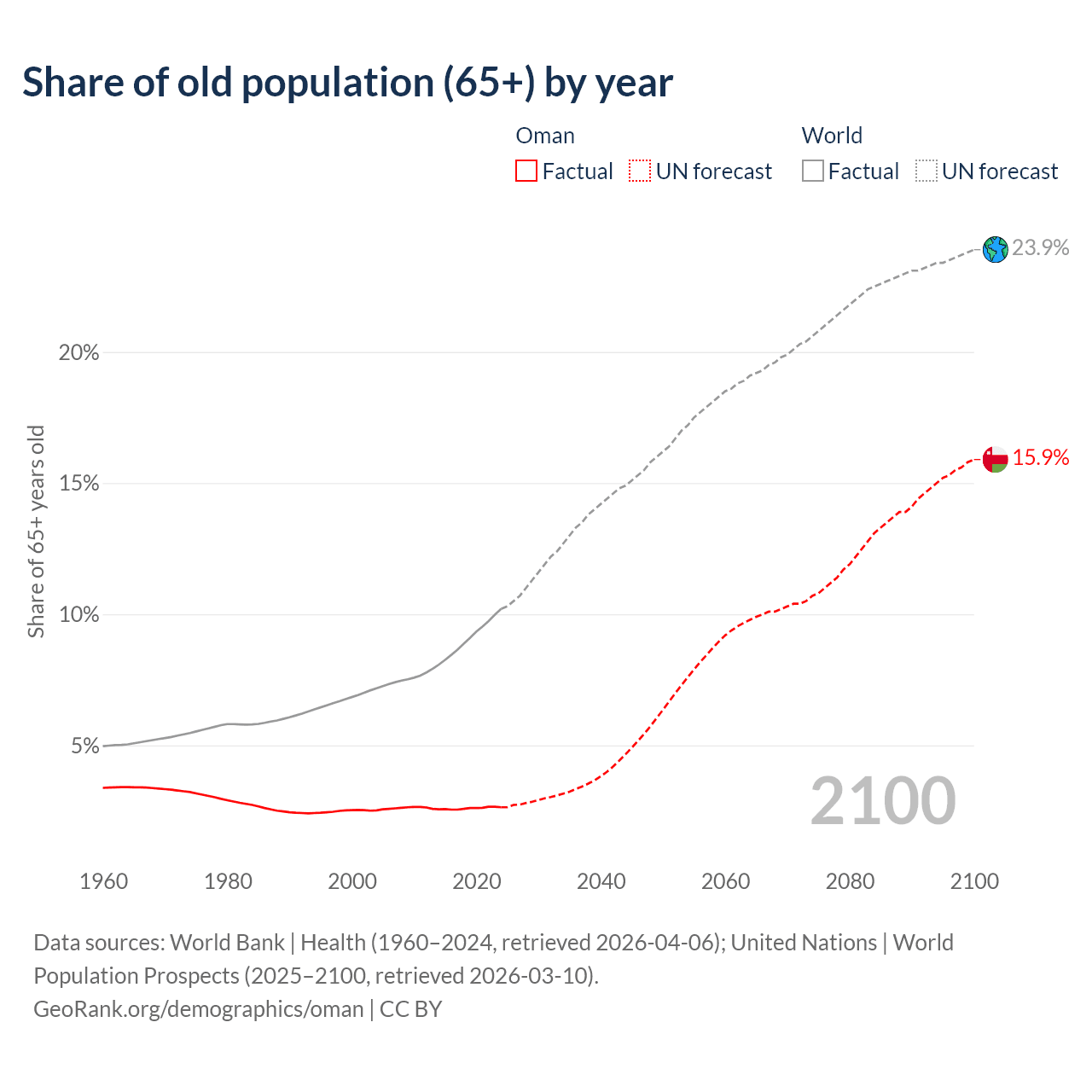
The share of older people aged 65 and over in Oman increased from 2.56% to 2.69% between 2005 and 2025.
Religion demographics
|
Oman
|
|
|---|---|
| Religion | Share of population |
| Islam | 81.8% |
| Hinduism | 9.53% |
| Christianity | 8.07% |
| Atheism | 0.14% |
| Buddhism | 0.11% |
| Judaism | 0.007% |
| All other | 0.35% |
Median age map

Data sources: World Bank | Health (1960–2025, retrieved 2026-07-08); U.S. Census Bureau (1960–2025, retrieved 2026-07-08).
GeoRank.org/demographics/oman | CC BY
Help us show the world through your eyes
Share a photo of your city and help others discover what it looks like to live there. Your contribution makes our data come alive.
Data sources:
- World Bank | Health (1960–2025, retrieved 2026-07-08)
- United Nations | World Population Prospects (1950–2100, retrieved 2026-07-08)
- U.S. Census Bureau (1960–2025, retrieved 2026-07-08)
- Pew Research Center (2020, retrieved 2026-07-08)
Creative Commons Attribution (CC BY) — you’re free to copy, share, remix, adapt, and use even commercially as long as you give appropriate credit and clearly indicate if you made changes. Other sources may be subject to different license terms.