The latest officially reported population of Brazil was 212,812,405 in 2025 vs 2,360,527 people in Moldova in 2025. In 2026, based on the adjusted UN estimation, the current Brazil's population is 213,964,342 people compared to 2,328,600 in Moldova.
Population statistics:
- Brazil's population is 91.9 times bigger than Moldova's.
- Brazil is ranked the 7th most populous country in the world, while Moldova is the 145th.
- The countries together account for 2.6% of the world: 2.57% for Brazil vs 0.03% for Moldova.
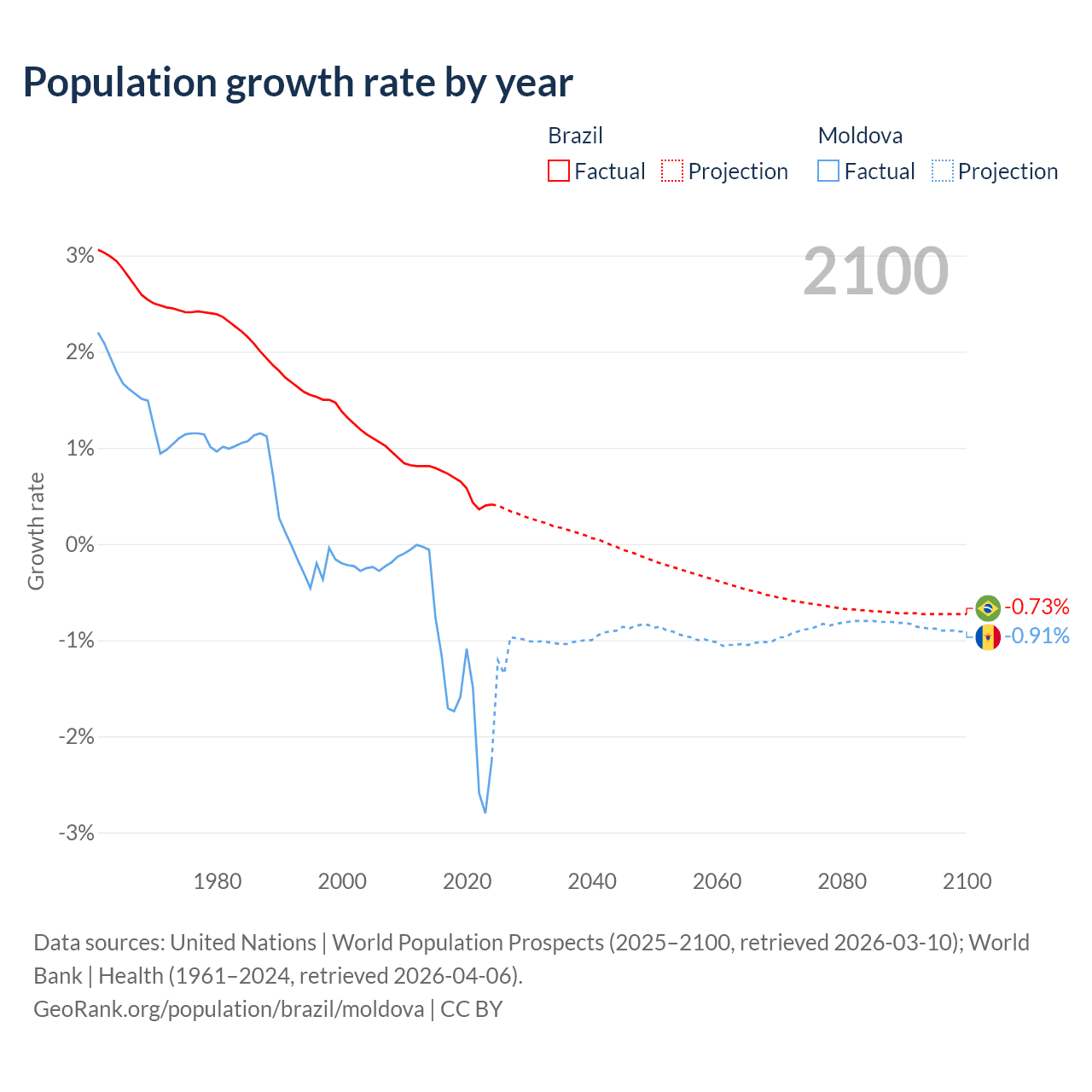
- For the last 10 years, Brazil has had an average growth rate of +0.56% per year vs -1.72% in Moldova.
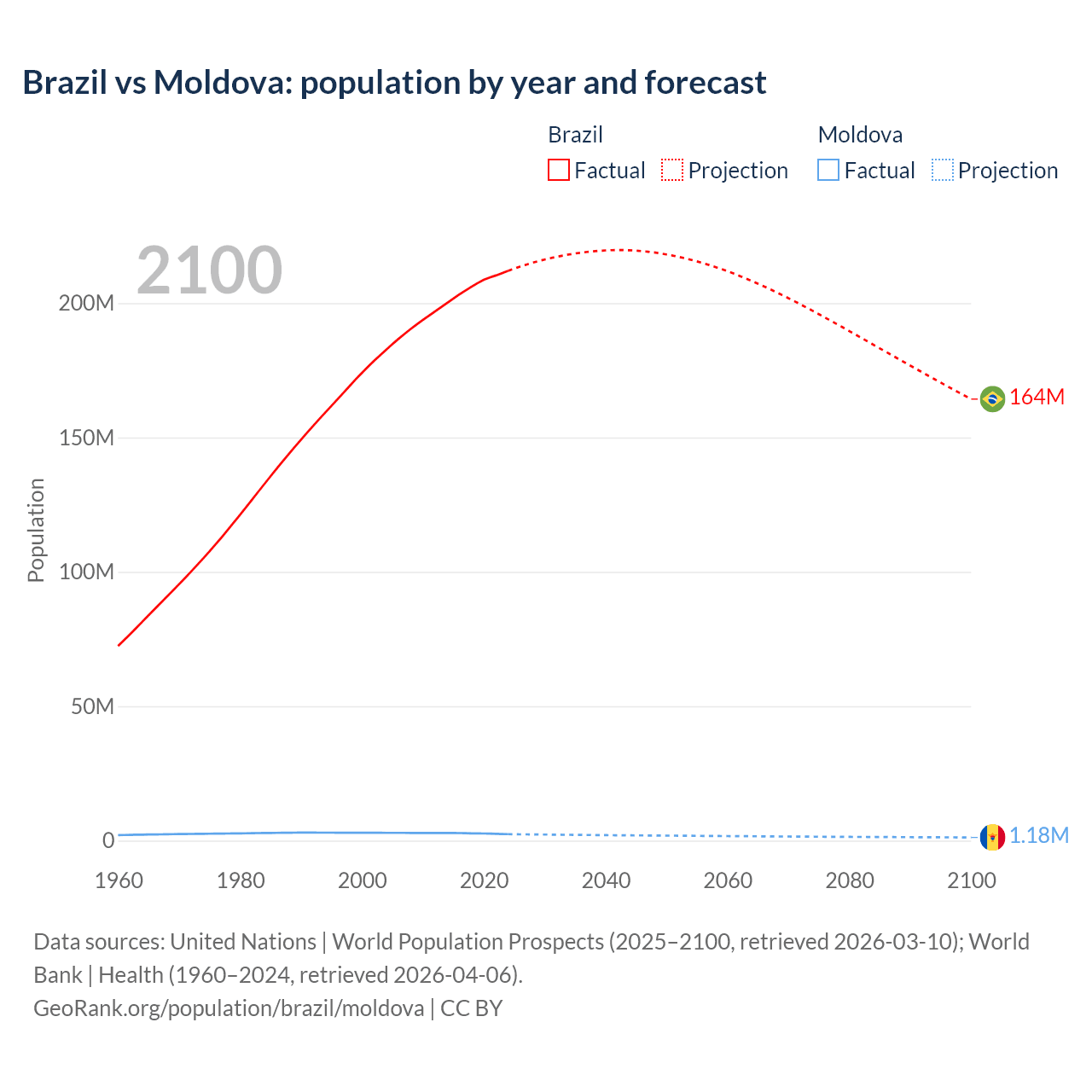
- Since 2006, the population of Brazil has increased from 187M people to 214M (14.6% growth), while Moldova has declined from 2.88M to 2.33M (19.2% decline).
Brazil vs Moldova: population by year and forecast
| Year | Population | |
|---|---|---|
 Brazil
|
 Moldova
|
|
| 2100 | 164,266,855 | 1,169,570 |
| 2099 | 165,476,254 | 1,180,272 |
| 2098 | 166,696,264 | 1,191,113 |
| 2097 | 167,929,414 | 1,201,972 |
| 2096 | 169,170,182 | 1,212,932 |
| 2095 | 170,418,279 | 1,223,967 |
| 2094 | 171,673,285 | 1,234,876 |
| 2093 | 172,929,867 | 1,245,808 |
| 2092 | 174,196,660 | 1,256,689 |
| 2091 | 175,465,250 | 1,267,532 |
| 2090 | 176,741,676 | 1,278,123 |
| 2089 | 178,016,467 | 1,288,741 |
| 2088 | 179,298,655 | 1,299,412 |
| 2087 | 180,582,637 | 1,309,994 |
| 2086 | 181,869,555 | 1,320,672 |
| 2085 | 183,154,436 | 1,331,516 |
| 2084 | 184,439,572 | 1,342,188 |
| 2083 | 185,726,230 | 1,353,031 |
| 2082 | 187,015,781 | 1,363,961 |
| 2081 | 188,304,247 | 1,375,027 |
| 2080 | 189,585,345 | 1,386,252 |
| 2079 | 190,860,450 | 1,397,755 |
| 2078 | 192,128,265 | 1,409,455 |
| 2077 | 193,387,405 | 1,421,568 |
| 2076 | 194,635,237 | 1,433,504 |
| 2075 | 195,871,705 | 1,445,874 |
| 2074 | 197,098,086 | 1,458,696 |
| 2073 | 198,312,538 | 1,471,729 |
| 2072 | 199,508,048 | 1,485,296 |
| 2071 | 200,684,948 | 1,499,224 |
| 2070 | 201,838,290 | 1,513,979 |
| 2069 | 202,969,511 | 1,528,841 |
| 2068 | 204,078,136 | 1,544,390 |
| 2067 | 205,156,343 | 1,560,256 |
| 2066 | 206,210,336 | 1,576,276 |
| 2065 | 207,233,670 | 1,592,761 |
| 2064 | 208,223,021 | 1,609,631 |
| 2063 | 209,184,325 | 1,626,510 |
| 2062 | 210,111,930 | 1,643,849 |
| 2061 | 211,000,165 | 1,661,290 |
| 2060 | 211,851,790 | 1,679,059 |
| 2059 | 212,667,148 | 1,696,440 |
| 2058 | 213,439,165 | 1,713,694 |
| 2057 | 214,172,487 | 1,730,910 |
| 2056 | 214,860,969 | 1,748,393 |
| 2055 | 215,511,064 | 1,765,554 |
| 2054 | 216,119,176 | 1,782,642 |
| 2053 | 216,684,051 | 1,799,510 |
| 2052 | 217,203,400 | 1,816,030 |
| 2051 | 217,673,624 | 1,832,448 |
| 2050 | 218,102,997 | 1,848,307 |
| 2049 | 218,492,176 | 1,864,603 |
| 2048 | 218,825,106 | 1,880,438 |
| 2047 | 219,107,600 | 1,896,381 |
| 2046 | 219,337,375 | 1,912,640 |
| 2045 | 219,518,678 | 1,929,525 |
| 2044 | 219,643,532 | 1,946,354 |
| 2043 | 219,714,087 | 1,964,017 |
| 2042 | 219,730,173 | 1,982,068 |
| 2041 | 219,688,816 | 2,000,545 |
| 2040 | 219,589,786 | 2,019,832 |
| 2039 | 219,450,960 | 2,040,153 |
| 2038 | 219,263,564 | 2,060,750 |
| 2037 | 219,033,555 | 2,081,833 |
| 2036 | 218,758,565 | 2,103,318 |
| 2035 | 218,441,478 | 2,125,527 |
| 2034 | 218,079,673 | 2,147,859 |
| 2033 | 217,677,081 | 2,170,311 |
| 2032 | 217,230,117 | 2,192,598 |
| 2031 | 216,739,295 | 2,215,052 |
| 2030 | 216,202,357 | 2,237,961 |
| 2029 | 215,618,762 | 2,260,762 |
| 2028 | 214,992,547 | 2,283,416 |
| 2027 | 214,315,680 | 2,305,981 |
| 2026 | 213,593,266 | 2,328,600 |
| 2025 | 212,812,405 | 2,360,527 |
| 2024 | 211,998,573 | 2,402,306 |
| 2023 | 211,140,729 | 2,457,783 |
| 2022 | 210,306,415 | 2,528,654 |
| 2021 | 209,550,294 | 2,595,809 |
| 2020 | 208,660,842 | 2,635,130 |
| 2019 | 207,455,459 | 2,664,224 |
| 2018 | 206,107,261 | 2,707,203 |
| 2017 | 204,703,445 | 2,755,189 |
| 2016 | 203,218,114 | 2,803,186 |
| 2015 | 201,675,532 | 2,835,978 |
| 2014 | 200,085,127 | 2,857,815 |
| 2013 | 198,478,299 | 2,859,558 |
| 2012 | 196,876,111 | 2,860,324 |
| 2011 | 195,284,734 | 2,860,699 |
| 2010 | 193,701,929 | 2,862,354 |
| 2009 | 192,079,951 | 2,865,213 |
| 2008 | 190,367,302 | 2,868,833 |
| 2007 | 188,552,320 | 2,874,299 |
| 2006 | 186,653,106 | 2,880,967 |
| 2005 | 184,688,101 | 2,888,985 |
| 2004 | 182,675,143 | 2,896,023 |
| 2003 | 180,622,688 | 2,903,198 |
| 2002 | 178,503,484 | 2,911,385 |
| 2001 | 176,301,203 | 2,918,135 |
| 2000 | 174,018,282 | 2,924,668 |
| 1999 | 171,641,543 | 2,930,622 |
| 1998 | 169,159,655 | 2,935,227 |
| 1997 | 166,661,659 | 2,936,413 |
| 1996 | 164,202,549 | 2,947,293 |
| 1995 | 161,735,073 | 2,953,200 |
| 1994 | 159,265,006 | 2,966,745 |
| 1993 | 156,794,577 | 2,975,966 |
| 1992 | 154,275,079 | 2,980,965 |
| 1991 | 151,724,256 | 2,981,566 |
| 1990 | 149,143,223 | 2,977,912 |
| 1989 | 146,502,972 | 2,970,039 |
| 1988 | 143,826,357 | 2,948,891 |
| 1987 | 141,104,944 | 2,916,306 |
| 1986 | 138,336,370 | 2,883,057 |
| 1985 | 135,515,595 | 2,850,787 |
| 1984 | 132,658,864 | 2,820,518 |
| 1983 | 129,790,077 | 2,791,207 |
| 1982 | 126,923,155 | 2,763,101 |
| 1981 | 124,063,109 | 2,735,987 |
| 1980 | 121,207,461 | 2,708,675 |
| 1979 | 118,380,821 | 2,683,035 |
| 1978 | 115,600,942 | 2,656,211 |
| 1977 | 112,875,292 | 2,626,298 |
| 1976 | 110,213,349 | 2,596,491 |
| 1975 | 107,619,565 | 2,566,998 |
| 1974 | 105,089,675 | 2,538,164 |
| 1973 | 102,600,976 | 2,510,584 |
| 1972 | 100,146,797 | 2,484,742 |
| 1971 | 97,739,273 | 2,460,611 |
| 1970 | 95,375,651 | 2,437,590 |
| 1969 | 93,045,777 | 2,408,469 |
| 1968 | 90,741,240 | 2,373,073 |
| 1967 | 88,446,124 | 2,337,695 |
| 1966 | 86,139,359 | 2,301,871 |
| 1965 | 83,817,583 | 2,265,287 |
| 1964 | 81,488,595 | 2,228,000 |
| 1963 | 79,164,235 | 2,188,895 |
| 1962 | 76,865,323 | 2,147,227 |
| 1961 | 74,605,447 | 2,103,327 |
| 1960 | 72,388,126 | 2,058,020 |
Data sources: United Nations | World Population Prospects (2026–2100, retrieved 2026-07-08); World Bank | Health (1960–2025, retrieved 2026-07-08).
GeoRank.org/population/brazil/moldova | CC BY 
From 2006 to 2016, the population of Brazil increased by 16,565,008 people (a 8.87% growth), while Moldova lost 77,781 people (a 2.7% decline).
For the next 10 years, from 2016 to 2026, Brazil gained 10,746,228 people (a 5.29% growth), while Moldova's population decreased by 474,586 people (a 16.9% decline).
Brazil was ranked 5th most populous country in 2006 and is 7th in 2026. Moldova was ranked 134th in 2006 and ranked 145th now.
The UN's World Population Prospects forecasts that in 24 years (in 2050) Brazil's population will grow by 1.93% to 218,102,997 people with a rank change from 7th to 9th. The population of Moldova will decrease by 20.6% to 1,848,307 people and rank change from 145th to 150th.
Brazil is projected to reach its peak in 2042 at 220M people, while Moldova's population already peaked in 1991 at 2.98M people and is projected to decrease to 1.17M people by 2100.
Population growth rate by year
| Year | Growth rate | |
|---|---|---|
|
Brazil
|
Moldova
|
|
| 2100 | -0.73% | -0.91% |
| 2099 | -0.73% | -0.91% |
| 2098 | -0.73% | -0.9% |
| 2097 | -0.73% | -0.9% |
| 2096 | -0.73% | -0.9% |
| 2095 | -0.73% | -0.88% |
| 2094 | -0.73% | -0.88% |
| 2093 | -0.73% | -0.87% |
| 2092 | -0.72% | -0.86% |
| 2091 | -0.72% | -0.83% |
| 2090 | -0.72% | -0.82% |
| 2089 | -0.72% | -0.82% |
| 2088 | -0.71% | -0.81% |
| 2087 | -0.71% | -0.81% |
| 2086 | -0.7% | -0.81% |
| 2085 | -0.7% | -0.8% |
| 2084 | -0.69% | -0.8% |
| 2083 | -0.69% | -0.8% |
| 2082 | -0.68% | -0.8% |
| 2081 | -0.68% | -0.81% |
| 2080 | -0.67% | -0.82% |
| 2079 | -0.66% | -0.83% |
| 2078 | -0.65% | -0.85% |
| 2077 | -0.64% | -0.83% |
| 2076 | -0.63% | -0.86% |
| 2075 | -0.62% | -0.88% |
| 2074 | -0.61% | -0.89% |
| 2073 | -0.6% | -0.91% |
| 2072 | -0.59% | -0.93% |
| 2071 | -0.57% | -0.97% |
| 2070 | -0.56% | -0.97% |
| 2069 | -0.54% | -1.01% |
| 2068 | -0.53% | -1.02% |
| 2067 | -0.51% | -1.02% |
| 2066 | -0.49% | -1.03% |
| 2065 | -0.48% | -1.05% |
| 2064 | -0.46% | -1.04% |
| 2063 | -0.44% | -1.05% |
| 2062 | -0.42% | -1.05% |
| 2061 | -0.4% | -1.06% |
| 2060 | -0.38% | -1.02% |
| 2059 | -0.36% | -1.01% |
| 2058 | -0.34% | -0.99% |
| 2057 | -0.32% | -1% |
| 2056 | -0.3% | -0.97% |
| 2055 | -0.28% | -0.96% |
| 2054 | -0.26% | -0.94% |
| 2053 | -0.24% | -0.91% |
| 2052 | -0.22% | -0.9% |
| 2051 | -0.2% | -0.86% |
| 2050 | -0.18% | -0.87% |
| 2049 | -0.15% | -0.84% |
| 2048 | -0.13% | -0.84% |
| 2047 | -0.1% | -0.85% |
| 2046 | -0.08% | -0.88% |
| 2045 | -0.06% | -0.86% |
| 2044 | -0.03% | -0.9% |
| 2043 | -0.007% | -0.91% |
| 2042 | 0.02% | -0.92% |
| 2041 | 0.05% | -0.95% |
| 2040 | 0.06% | -1% |
| 2039 | 0.09% | -1% |
| 2038 | 0.11% | -1.01% |
| 2037 | 0.13% | -1.02% |
| 2036 | 0.15% | -1.04% |
| 2035 | 0.17% | -1.04% |
| 2034 | 0.18% | -1.03% |
| 2033 | 0.21% | -1.02% |
| 2032 | 0.23% | -1.01% |
| 2031 | 0.25% | -1.02% |
| 2030 | 0.27% | -1.01% |
| 2029 | 0.29% | -0.99% |
| 2028 | 0.32% | -0.98% |
| 2027 | 0.34% | -0.97% |
| 2026 | 0.37% | -1.35% |
| 2025 | 0.38% | -1.74% |
| 2024 | 0.41% | -2.26% |
| 2023 | 0.4% | -2.8% |
| 2022 | 0.36% | -2.59% |
| 2021 | 0.43% | -1.49% |
| 2020 | 0.58% | -1.09% |
| 2019 | 0.65% | -1.59% |
| 2018 | 0.69% | -1.74% |
| 2017 | 0.73% | -1.71% |
| 2016 | 0.76% | -1.16% |
| 2015 | 0.79% | -0.76% |
| 2014 | 0.81% | -0.06% |
| 2013 | 0.81% | -0.03% |
| 2012 | 0.81% | -0.01% |
| 2011 | 0.82% | -0.06% |
| 2010 | 0.84% | -0.1% |
| 2009 | 0.9% | -0.13% |
| 2008 | 0.96% | -0.19% |
| 2007 | 1.02% | -0.23% |
| 2006 | 1.06% | -0.28% |
| 2005 | 1.1% | -0.24% |
| 2004 | 1.14% | -0.25% |
| 2003 | 1.19% | -0.28% |
| 2002 | 1.25% | -0.23% |
| 2001 | 1.31% | -0.22% |
| 2000 | 1.38% | -0.2% |
| 1999 | 1.47% | -0.16% |
| 1998 | 1.5% | -0.04% |
| 1997 | 1.5% | -0.37% |
| 1996 | 1.53% | -0.2% |
| 1995 | 1.55% | -0.46% |
| 1994 | 1.58% | -0.31% |
| 1993 | 1.63% | -0.17% |
| 1992 | 1.68% | -0.02% |
| 1991 | 1.73% | 0.12% |
| 1990 | 1.8% | 0.27% |
| 1989 | 1.86% | 0.72% |
| 1988 | 1.93% | 1.12% |
| 1987 | 2% | 1.15% |
| 1986 | 2.08% | 1.13% |
| 1985 | 2.15% | 1.07% |
| 1984 | 2.21% | 1.05% |
| 1983 | 2.26% | 1.02% |
| 1982 | 2.31% | 0.99% |
| 1981 | 2.36% | 1.01% |
| 1980 | 2.39% | 0.96% |
| 1979 | 2.4% | 1.01% |
| 1978 | 2.41% | 1.14% |
| 1977 | 2.42% | 1.15% |
| 1976 | 2.41% | 1.15% |
| 1975 | 2.41% | 1.14% |
| 1974 | 2.43% | 1.1% |
| 1973 | 2.45% | 1.04% |
| 1972 | 2.46% | 0.98% |
| 1971 | 2.48% | 0.94% |
| 1970 | 2.5% | 1.21% |
| 1969 | 2.54% | 1.49% |
| 1968 | 2.59% | 1.51% |
| 1967 | 2.68% | 1.56% |
| 1966 | 2.77% | 1.61% |
| 1965 | 2.86% | 1.67% |
| 1964 | 2.94% | 1.79% |
| 1963 | 2.99% | 1.94% |
| 1962 | 3.03% | 2.09% |
| 1961 | 3.06% | 2.2% |
Data sources: United Nations | World Population Prospects (2026–2100, retrieved 2026-07-08); World Bank | Health (1961–2025, retrieved 2026-07-08).
GeoRank.org/population/brazil/moldova | CC BY
In 2025, the population of Brazil grew by 0.38%, while Moldova's population declined by 1.74%.
Live population counters
|
Brazil
|
Moldova
|
|
|---|---|---|
| Current population |
213964342
|
2328600
|
| Population rank | 7/197 | 145/197 |
| Percent of world population | 2.57% | 0.03% |
| One net population change |
38.9 seconds
|
12.6 minutes
|
| One birth every |
12.3 seconds
|
20.7 minutes
|
| One death every |
21 seconds
|
15.8 minutes
|
| Daily growth/decline | +2,230 | -114 |
| Annual growth/decline | +813,832 | -41,779 |
| Annual growth/decline rate | +0.38% | -1.74% |
| Population growth rate rank | 141/197 | 196/197 |
| One migration net change every |
2.43 minutes
|
17.7 minutes
|
| Annual migration change | -217,283 | -29,766 |
| Net migration rank | 186/196 | 164/196 |
| Foreign-born residents | 1,406,299 | 188,207 |
| Foreign-born residents rank | 48/195 | 116/195 |
| Foreign-born share of population | 0.7% | 6.2% |
| Foreign-born share rank | 163/195 | 85/195 |
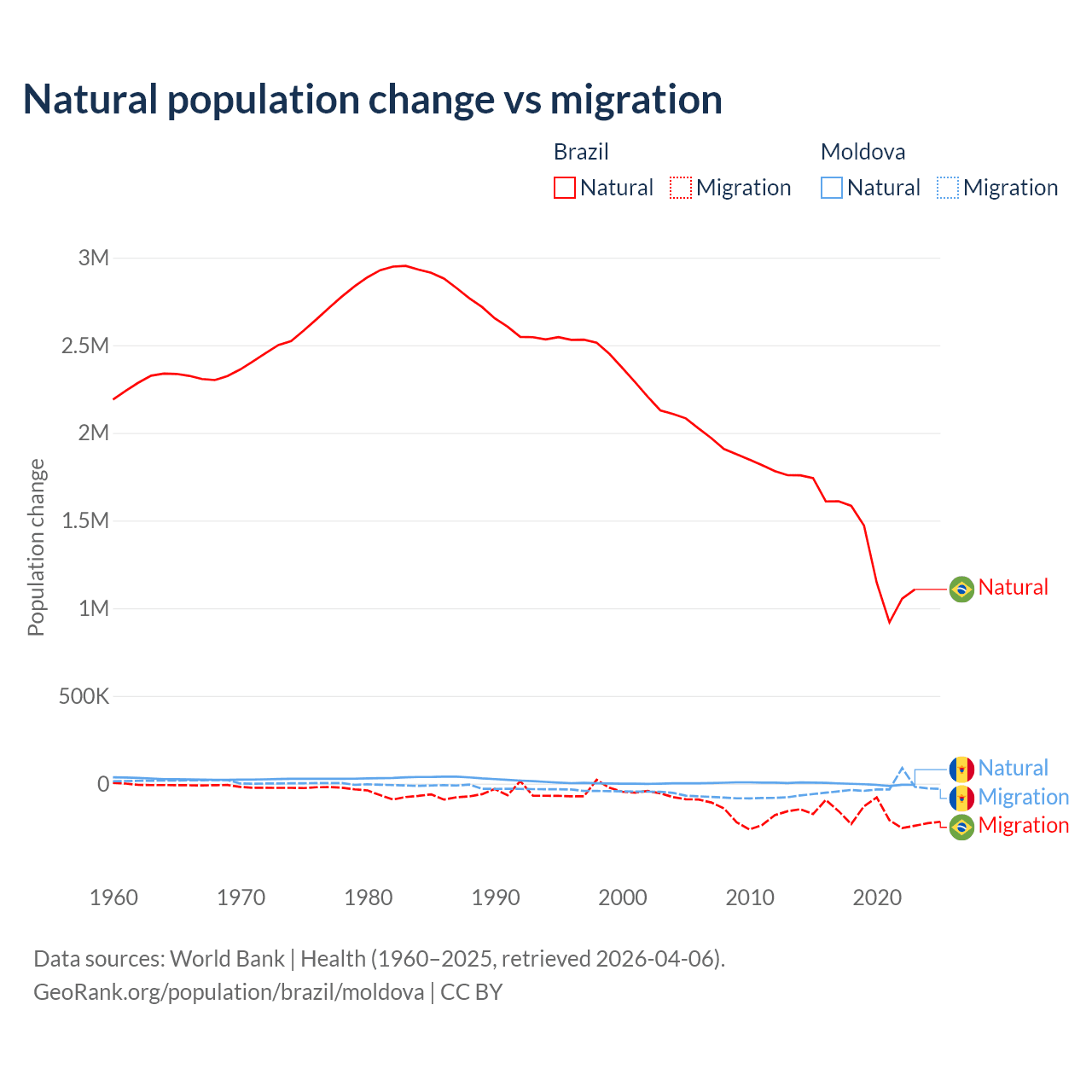
Natural population change vs migration
| Year | Population change | |||
|---|---|---|---|---|
|
Brazil
|
Moldova
|
|||
| Natural | Migration | Natural | Migration | |
| 2025 | - | -217,283 | - | -29,766 |
| 2024 | 1,073,773 | -225,510 | -7,767 | -27,088 |
| 2023 | 1,107,434 | -240,059 | -7,007 | -18,570 |
| 2022 | 1,054,897 | -253,639 | -6,385 | 89,154 |
| 2021 | 919,507 | -208,581 | -13,444 | -33,405 |
| 2020 | 1,146,174 | -78,437 | -7,067 | -33,405 |
| 2019 | 1,472,104 | -129,216 | -3,416 | -41,233 |
| 2018 | 1,583,935 | -230,334 | -961 | -36,085 |
| 2017 | 1,610,402 | -156,296 | 1,402 | -43,871 |
| 2016 | 1,609,488 | -92,989 | 4,580 | -51,642 |
| 2015 | 1,742,275 | -173,611 | 6,049 | -59,399 |
| 2014 | 1,757,948 | -145,732 | 7,248 | -67,175 |
| 2013 | 1,758,716 | -157,228 | 3,537 | -77,571 |
| 2012 | 1,782,516 | -179,707 | 5,581 | -81,215 |
| 2011 | 1,815,758 | -235,860 | 5,948 | -82,271 |
| 2010 | 1,847,336 | -261,539 | 7,456 | -84,039 |
| 2009 | 1,878,542 | -220,207 | 7,492 | -83,546 |
| 2008 | 1,908,051 | -141,056 | 5,210 | -79,593 |
| 2007 | 1,970,372 | -107,481 | 3,490 | -75,734 |
| 2006 | 2,026,119 | -90,634 | 2,406 | -72,061 |
| 2005 | 2,083,281 | -88,868 | 2,005 | -68,681 |
| 2004 | 2,108,072 | -76,661 | 1,714 | -52,491 |
| 2003 | 2,128,819 | -55,350 | -322 | -46,947 |
| 2002 | 2,207,017 | -42,008 | -1,249 | -45,833 |
| 2001 | 2,291,210 | -51,600 | -718 | -45,043 |
| 2000 | 2,372,043 | -45,800 | -324 | -43,854 |
| 1999 | 2,450,869 | -23,497 | 642 | -43,111 |
| 1998 | 2,514,728 | 21,666 | 2,140 | -41,975 |
| 1997 | 2,531,758 | -72,392 | 4,669 | -41,743 |
| 1996 | 2,530,690 | -71,943 | 2,655 | -33,369 |
| 1995 | 2,546,195 | -69,963 | 5,534 | -31,975 |
| 1994 | 2,532,951 | -68,961 | 9,921 | -31,616 |
| 1993 | 2,545,874 | -69,070 | 13,886 | -31,526 |
| 1992 | 2,547,698 | 14,394 | 17,373 | -30,136 |
| 1991 | 2,606,167 | -66,600 | 21,127 | -29,204 |
| 1990 | 2,652,959 | -30,555 | 25,824 | -30,053 |
| 1989 | 2,717,923 | -60,023 | 29,638 | -29,307 |
| 1988 | 2,768,082 | -72,825 | 35,608 | -4,989 |
| 1987 | 2,825,485 | -77,800 | 40,122 | -10,796 |
| 1986 | 2,880,440 | -90,973 | 39,463 | -8,769 |
| 1985 | 2,912,908 | -60,879 | 38,060 | -10,627 |
| 1984 | 2,931,496 | -70,035 | 38,108 | -12,732 |
| 1983 | 2,952,335 | -76,322 | 36,076 | -10,543 |
| 1982 | 2,948,552 | -90,766 | 32,814 | -8,412 |
| 1981 | 2,928,262 | -65,971 | 31,360 | -6,452 |
| 1980 | 2,887,768 | -38,918 | 30,053 | -3,693 |
| 1979 | 2,836,759 | -32,503 | 28,322 | -6,912 |
| 1978 | 2,778,815 | -23,416 | 27,622 | 3,483 |
| 1977 | 2,715,328 | -19,478 | 27,707 | 3,245 |
| 1976 | 2,648,647 | -20,612 | 27,801 | 2,885 |
| 1975 | 2,585,130 | -25,499 | 27,677 | 2,355 |
| 1974 | 2,524,254 | -24,093 | 27,219 | 1,785 |
| 1973 | 2,501,309 | -24,071 | 25,967 | 1,156 |
| 1972 | 2,454,698 | -23,584 | 24,626 | 481 |
| 1971 | 2,407,319 | -23,421 | 23,359 | -61 |
| 1970 | 2,362,073 | -18,779 | 22,314 | 606 |
| 1969 | 2,324,190 | -7,763 | 21,768 | 20,561 |
| 1968 | 2,301,561 | -8,856 | 22,005 | 19,830 |
| 1967 | 2,307,560 | -10,033 | 22,654 | 19,175 |
| 1966 | 2,325,332 | -9,317 | 23,720 | 18,601 |
| 1965 | 2,336,415 | -8,824 | 24,916 | 18,066 |
| 1964 | 2,338,478 | -8,146 | 25,860 | 17,509 |
| 1963 | 2,326,400 | -8,136 | 29,382 | 16,816 |
| 1962 | 2,286,666 | -7,171 | 32,082 | 15,884 |
| 1961 | 2,240,178 | 75 | 35,180 | 14,818 |
| 1960 | 2,190,392 | 4,066 | 36,352 | 13,697 |
Data sources: World Bank | Health (1960–2025, retrieved 2026-07-08).
GeoRank.org/population/brazil/moldova | CC BY
Over the last 10 years, 88.2% of the population change in Brazil is from natural causes (a gain of 13,319,989 people) and 11.8% is from migration (a loss of 1,788,672 people). In Moldova 11.7% is from natural causes (a loss of 34,016 people) and 88.3% is from migration (a loss of 255,544 people).
As of 2024, 1,406,299 residents or 0.7% of the population were not native-born in Brazil, compared to 188,207 people or 6.2% in Moldova.
Biggest cities by population
|
Brazil
|
|
|---|---|
| City | Population |
| Sao Paulo | 11.5M |
| Rio de Janeiro | 6.21M |
| Brasilia | 3M |
| Fortaleza | 2.58M |
| Salvador | 2.42M |
| Belo Horizonte | 2.32M |
| Manaus | 2.3M |
| Curitiba | 1.77M |
| Recife | 1.49M |
| Goiania | 1.44M |
|
Moldova
|
|
|---|---|
| City | Population |
| Chisinau | 567K |
| Tiraspol | 134K |
| Balti | 91K |
| Bender | 76.2K |
| Ungheni | 26.5K |
| Dubasari | 25.1K |
| Cahul | 22.2K |
| Orhei | 22.2K |
| Soroca | 21.1K |
| Comrat | 19.1K |
Compare countries by 7 more topics
Population differences between Brazil and Moldova
|
Brazil
|
Moldova
|
|
|---|---|---|
| Life expectancy | 76.4 years | 71.6 years |
| Average age | 36.7 years | 39.6 years |
| Median age | 35.8 years | 39.6 years |
| Male:Female ratio | 49.2:50.8 | 46:54 |
| Fertility rate | 1.61 births per woman | 1.73 births per woman |
| Population density | 66.2 ppl/mi² | 183.1 ppl/mi² |
Population map with other countries

Data sources: World Bank | Health (1960–2025, retrieved 2026-07-08); United Nations | World Population Prospects (1960–2026, retrieved 2026-07-08); U.S. Census Bureau (1960–2025, retrieved 2026-07-08); Central Intelligence Agency (CIA) (2000–2019, retrieved 2026-07-08).
GeoRank.org/population/brazil/moldova | CC BY
Help us show the world through your eyes
Share a photo of your city and help others discover what it looks like to live there. Your contribution makes our data come alive.
Data sources:
- World Bank | Health (1960–2025, retrieved 2026-07-08)
- United Nations | World Population Prospects (1960–2100, retrieved 2026-07-08)
- U.S. Census Bureau (1960–2025, retrieved 2026-07-08)
- Wikidata (2026, retrieved 2026-07-08)
- Central Intelligence Agency (CIA) (2000–2019, retrieved 2026-07-08)
Creative Commons Attribution (CC BY) — you’re free to copy, share, remix, adapt, and use even commercially as long as you give appropriate credit and clearly indicate if you made changes. Other sources may be subject to different license terms.