Ghana's land area is 87,851 sq mi, and the total size is 92,099 sq mi, with inland water included. Ghana rankes 80/197 by total surface area.
- Occupies 0.15% of the land mass of all countries.
- 55.4% of its territory is agricultural land.
- Ghana has 0.26% of the world's agricultural land area.
- 35.2% of its area is covered by forests.
- Has 0.2% of the world's forests.
Ghana total size and land area
 Ghana
Ghana
|
Rank | |
|---|---|---|
| Total surface area |
92,099 sq mi |
80/197 |
| Share all of all countries' surface area | 0.05% | N/A |
| Land area |
87,851 sq mi |
81/197 |
| Share of all countries' land area | 0.15% | N/A |
| Population | 35,064,272 | 47/197 |
| Population density | 406 ppl/mi² | 63/197 |
Ghana's area by type
|
Ghana
|
Rank | |
|---|---|---|
| Forest area |
30,917 sq mi |
58/196 |
| Forest area as share of land | 35.2% | 81/196 |
| World's forests share | 0.2% | N/A |
Agricultural land

|
48,663 sq mi |
66/194 |
| Agricultural land share | 55.4% | 46/194 |
| Share of global agricultural land | 0.26% | N/A |
|
Arable land
|
18,185 sq mi |
51/191 |
| Arable land share | 20.7% | 52/191 |
|
Permanent cropland
|
10,454 sq mi |
15/192 |
| Permanent cropland share | 11.9% | 19/192 |
|
Water area
|
4,248 sq mi |
43/197 |
| Water as share of total area | 4.61% | 36/197 |
| Roads length |
68,049 mi |
52/176 |
| Land borders length |
1,504 mi |
79/197 |
| Coastline length |
335 mi |
90/197 |
| Share of marine protected waters | 0.1% | 130/155 |
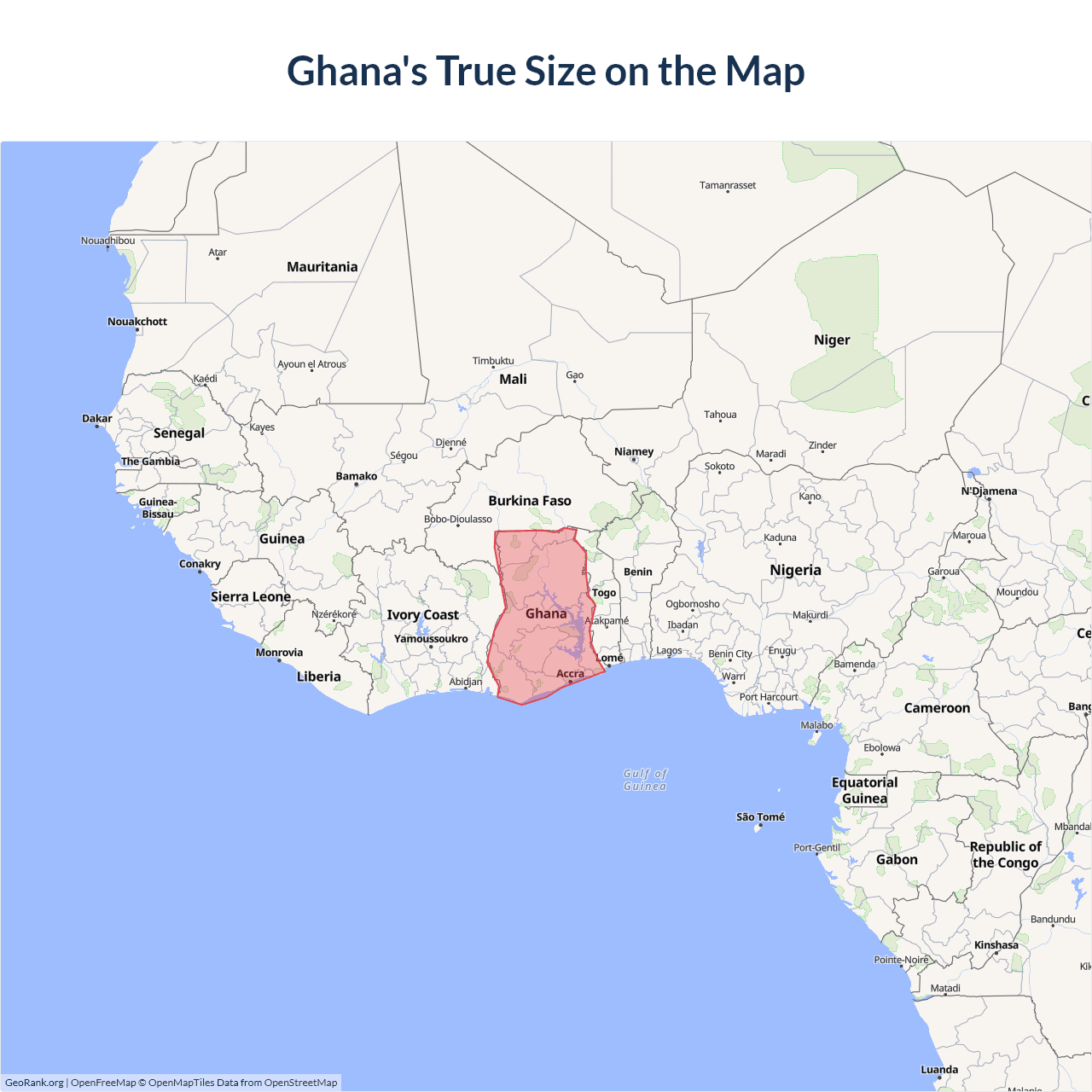
Ghana's size on the map

Data sources: World Bank | Agriculture & Rural Development (2026, retrieved 2026-07-08).
GeoRank.org/size/ghana | CC BY
The map above outlines the borders of Ghana but is not accurate for size comparison because it's a 2d map with Mercator projection that distorts territories near the poles. The farther a country is from the equator, the more magnified it appears. More about country size projections.
Compare countries by 7 more topics
Help us show the world through your eyes
Share a photo of your city and help others discover what it looks like to live there. Your contribution makes our data come alive.
Data sources:
- World Bank | Agriculture & Rural Development (2023–2026, retrieved 2026-07-08)
- Wikidata (2026, retrieved 2026-07-08)
- Central Intelligence Agency (CIA) (2025, retrieved 2026-07-08)
- United Nations | World Population Prospects (2026, retrieved 2026-07-08)
Total agricultural land encompasses all areas used for agriculture: territories under permanent and temporary crops and pastures. It includes land under flowering shrubs, fruit and nut trees, and vineyards, but excludes sites utilized for timber production.
Arable land encompasses fields utilized for temporary crop production, pastures, market or kitchen gardens, and temporarily fallowed land. Land abandoned due to shifting cultivation practices is not included.
Permanent cropland refers to farmland for the long-term cultivation of crops, such as coffee, cocoa, and rubber, which do not require replanting after each harvest. This category encompasses land with permanent crops like flowering shrubs, fruit and nut trees, and vines, but does not include land under trees for timber production.
Inland areas under water, such as large rivers, lakes, and some coastal waterways.
Creative Commons Attribution (CC BY) — you’re free to copy, share, remix, adapt, and use even commercially as long as you give appropriate credit and clearly indicate if you made changes. Other sources may be subject to different license terms.