Uzbekistan has a population density of 221.8 people per square mile, compared to the average of 144.1 people in other countries. Uzbekistan has 130,427 sq ft of land per person and ranks 103rd out of 197 countries (most to least densely populated).
Uzbekistan has 0.45% of the world's population and 0.3% of the total land area of all countries.
Uzbekistan population density by year
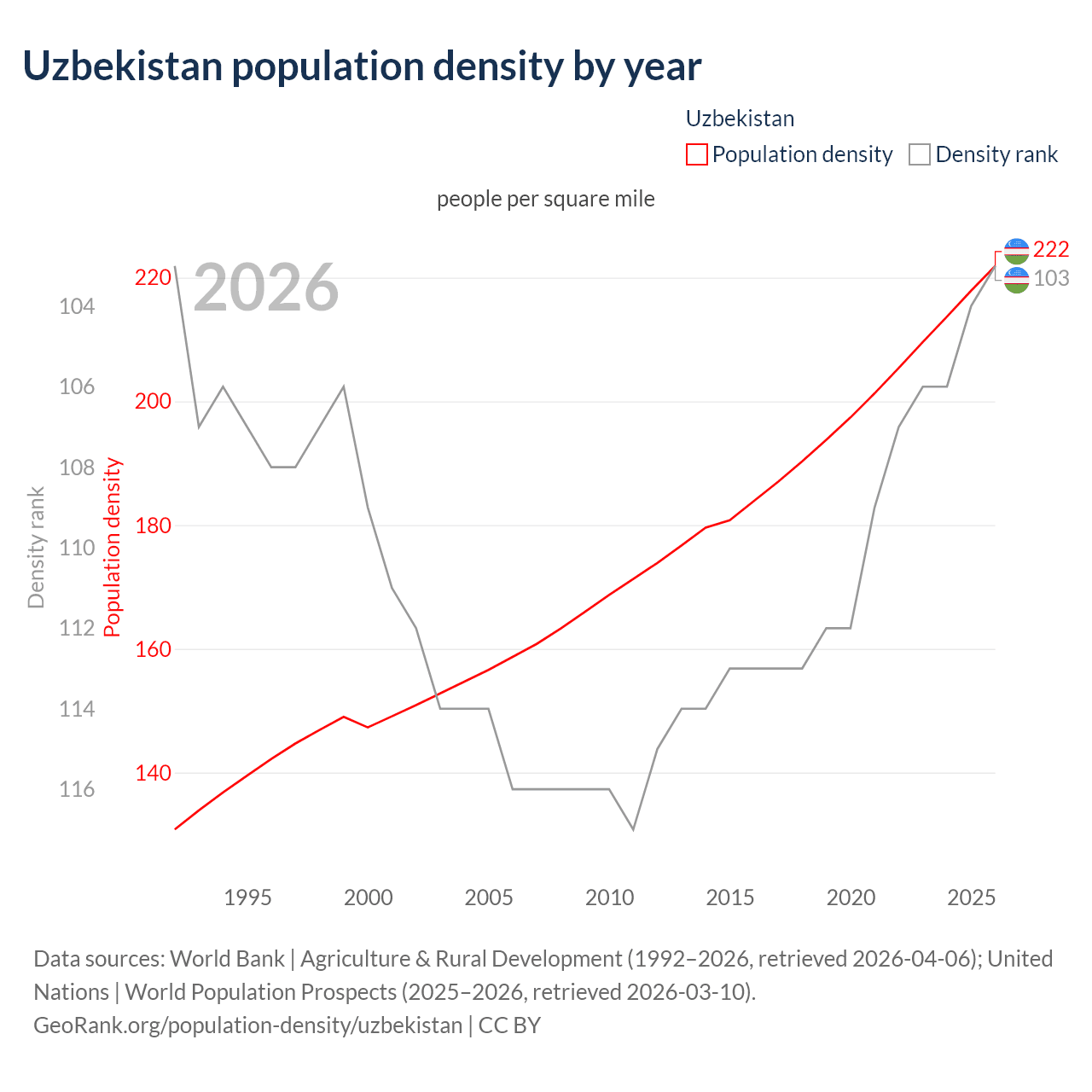
people per square mile
| Year | Population density | Density rank |
|---|---|---|
| 2026 | 221.8 | 103 |
| 2025 | 217.8 | 104 |
| 2024 | 213.7 | 106 |
| 2023 | 209.6 | 106 |
| 2022 | 205.4 | 107 |
| 2021 | 201.3 | 109 |
| 2020 | 197.4 | 112 |
| 2019 | 193.8 | 112 |
| 2018 | 190.3 | 113 |
| 2017 | 187 | 113 |
| 2016 | 183.9 | 113 |
| 2015 | 180.8 | 113 |
| 2014 | 179.6 | 114 |
| 2013 | 176.7 | 114 |
| 2012 | 173.9 | 115 |
| 2011 | 171.3 | 117 |
| 2010 | 168.7 | 116 |
| 2009 | 166 | 116 |
| 2008 | 163.3 | 116 |
| 2007 | 160.8 | 116 |
| 2006 | 158.7 | 116 |
| 2005 | 156.6 | 114 |
| 2004 | 154.7 | 114 |
| 2003 | 152.8 | 114 |
| 2002 | 150.9 | 112 |
| 2001 | 149.1 | 111 |
| 2000 | 147.3 | 109 |
| 1999 | 149 | 106 |
| 1998 | 146.9 | 107 |
| 1997 | 144.7 | 108 |
| 1996 | 142.2 | 108 |
| 1995 | 139.5 | 107 |
| 1994 | 136.8 | 106 |
| 1993 | 133.9 | 107 |
| 1992 | 130.8 | 103 |
Data sources: World Bank | Agriculture & Rural Development (1992–2026, retrieved 2026-07-08); United Nations | World Population Prospects (2026, retrieved 2026-07-08).
GeoRank.org/population-density/uzbekistan | CC BY 
This chart shows how population density in Uzbekistan has changed over time. From 2006 to 2026, population density increased by 39.8%. Uzbekistan ranked 116th by population density 20 years ago and ranks 103rd today.
Density metrics
 Uzbekistan
|
Rank | |
|---|---|---|
| Population density | 221.8 ppl/mi² | 103/197 |
| Population |
38082870
|
42/197 |
| Land area | 170,136 sq mi | 56/197 |
| Land area per capita | 128,008 sq ft | 94/197 |
| Rural population | 49% | 62/195 |
| Urban population | 51% | 134/195 |
| Living in agglomerations of 1M+ people | 7.76% | 89/197 |
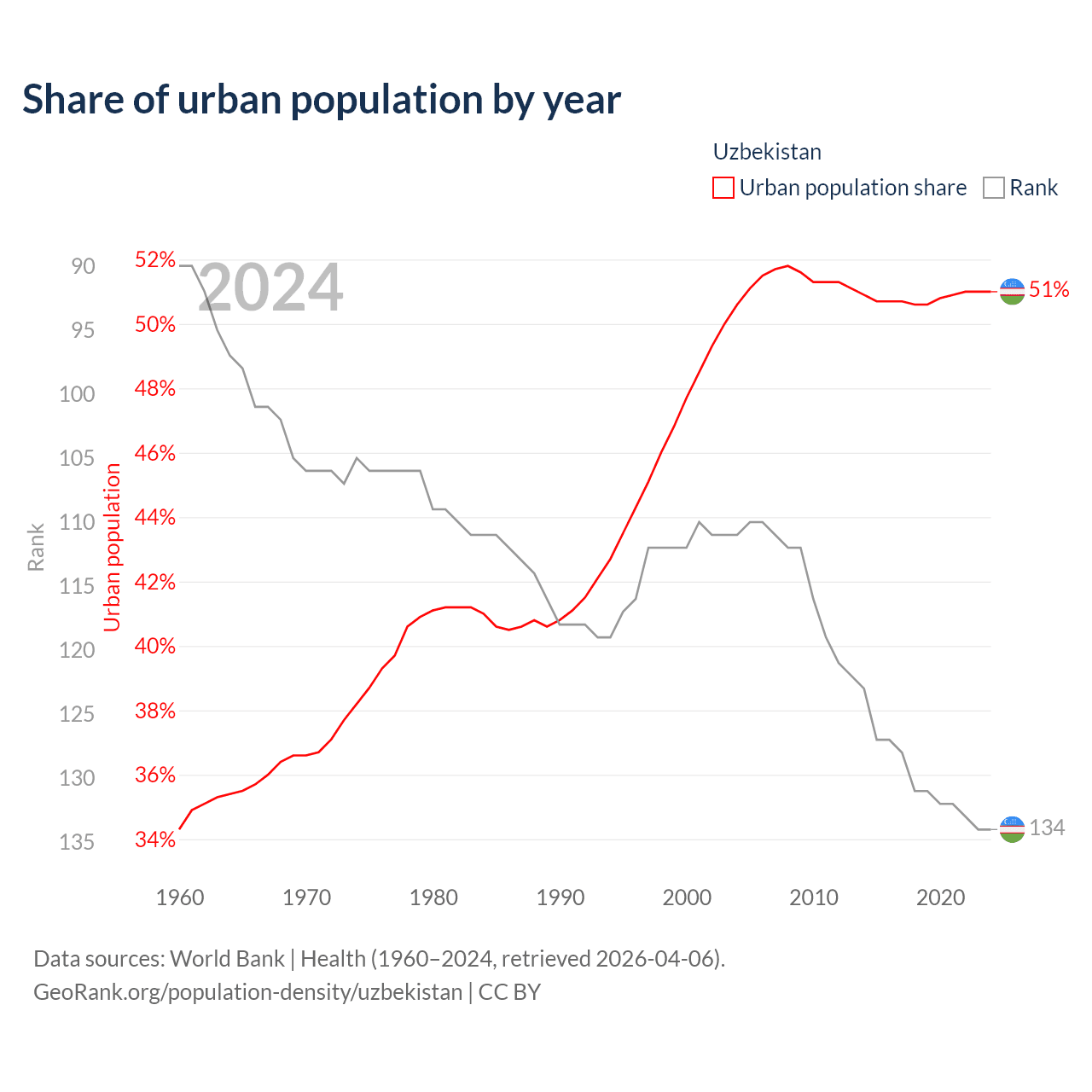
Share of urban population by year
| Year | Urban population | Rank |
|---|---|---|
| 2025 | 51% | 133 |
| 2024 | 51% | 134 |
| 2023 | 51% | 134 |
| 2022 | 51% | 133 |
| 2021 | 50.9% | 132 |
| 2020 | 50.8% | 132 |
| 2019 | 50.6% | 131 |
| 2018 | 50.6% | 131 |
| 2017 | 50.7% | 128 |
| 2016 | 50.7% | 127 |
| 2015 | 50.7% | 127 |
| 2014 | 50.9% | 123 |
| 2013 | 51.1% | 122 |
| 2012 | 51.3% | 121 |
| 2011 | 51.3% | 119 |
| 2010 | 51.3% | 116 |
| 2009 | 51.6% | 112 |
| 2008 | 51.8% | 112 |
| 2007 | 51.7% | 111 |
| 2006 | 51.5% | 110 |
| 2005 | 51.1% | 110 |
| 2004 | 50.6% | 111 |
| 2003 | 50% | 111 |
| 2002 | 49.3% | 111 |
| 2001 | 48.5% | 110 |
| 2000 | 47.7% | 112 |
| 1999 | 46.8% | 112 |
| 1998 | 46% | 112 |
| 1997 | 45.1% | 112 |
| 1996 | 44.3% | 116 |
| 1995 | 43.5% | 117 |
| 1994 | 42.7% | 119 |
| 1993 | 42.1% | 119 |
| 1992 | 41.5% | 118 |
| 1991 | 41.1% | 118 |
| 1990 | 40.8% | 118 |
| 1989 | 40.6% | 116 |
| 1988 | 40.8% | 114 |
| 1987 | 40.6% | 113 |
| 1986 | 40.5% | 112 |
| 1985 | 40.6% | 111 |
| 1984 | 41% | 111 |
| 1983 | 41.2% | 111 |
| 1982 | 41.2% | 110 |
| 1981 | 41.2% | 109 |
| 1980 | 41.1% | 109 |
| 1979 | 40.9% | 106 |
| 1978 | 40.6% | 106 |
| 1977 | 39.7% | 106 |
| 1976 | 39.3% | 106 |
| 1975 | 38.7% | 106 |
| 1974 | 38.2% | 105 |
| 1973 | 37.7% | 107 |
| 1972 | 37.1% | 106 |
| 1971 | 36.7% | 106 |
| 1970 | 36.6% | 106 |
| 1969 | 36.6% | 105 |
| 1968 | 36.4% | 102 |
| 1967 | 36% | 101 |
| 1966 | 35.7% | 101 |
| 1965 | 35.5% | 98 |
| 1964 | 35.4% | 97 |
| 1963 | 35.3% | 95 |
| 1962 | 35.1% | 92 |
| 1961 | 34.9% | 90 |
| 1960 | 34.3% | 90 |
Data sources: World Bank | Health (1960–2025, retrieved 2026-07-08).
GeoRank.org/population-density/uzbekistan | CC BY
This chart shows the share of urban population in Uzbekistan from 1960 to 2025: 34.3% lived in urban areas in 1960, 47.7% in 2000, and 51% in 2025.
Densely populated cities
Compare countries by 7 more topics
Population density in other countries

Data sources: World Bank | Agriculture & Rural Development (1961–2026, retrieved 2026-07-08); United Nations | World Population Prospects (1961–2026, retrieved 2026-07-08); U.S. Census Bureau (1961–2025, retrieved 2026-07-08); Central Intelligence Agency (CIA) (2000–2019, retrieved 2026-07-08).
GeoRank.org/population-density/uzbekistan | CC BY
Help us show the world through your eyes
Share a photo of your city and help others discover what it looks like to live there. Your contribution makes our data come alive.
Data sources:
- World Bank | Agriculture & Rural Development (1961–2026, retrieved 2026-07-08)
- United Nations | World Population Prospects (1961–2026, retrieved 2026-07-08)
- U.S. Census Bureau (1961–2025, retrieved 2026-07-08)
- Central Intelligence Agency (CIA) (2000–2025, retrieved 2026-07-08)
- Wikidata (2014–2025, retrieved 2026-07-08)
Creative Commons Attribution (CC BY) — you’re free to copy, share, remix, adapt, and use even commercially as long as you give appropriate credit and clearly indicate if you made changes. Other sources may be subject to different license terms.