Guinea-Bissau has a population density of 211.7 people per square mile compared to 1,400 people in the Netherlands. Guinea-Bissau has 172,858 sq ft of land per person vs 22,244 sq ft in the Netherlands. Guinea-Bissau and the Netherlands rank 108th and 17th by population density, respectively.
Population density is calculated as the ratio of population to land area. Guinea-Bissau has 0.03% of the world's population and 0.02% of all countries' land area, compared to 0.22% of the population and 0.02% of the land area for the Netherlands, making the population density in Guinea-Bissau 84.9% lower than in the Netherlands.
Population density by year
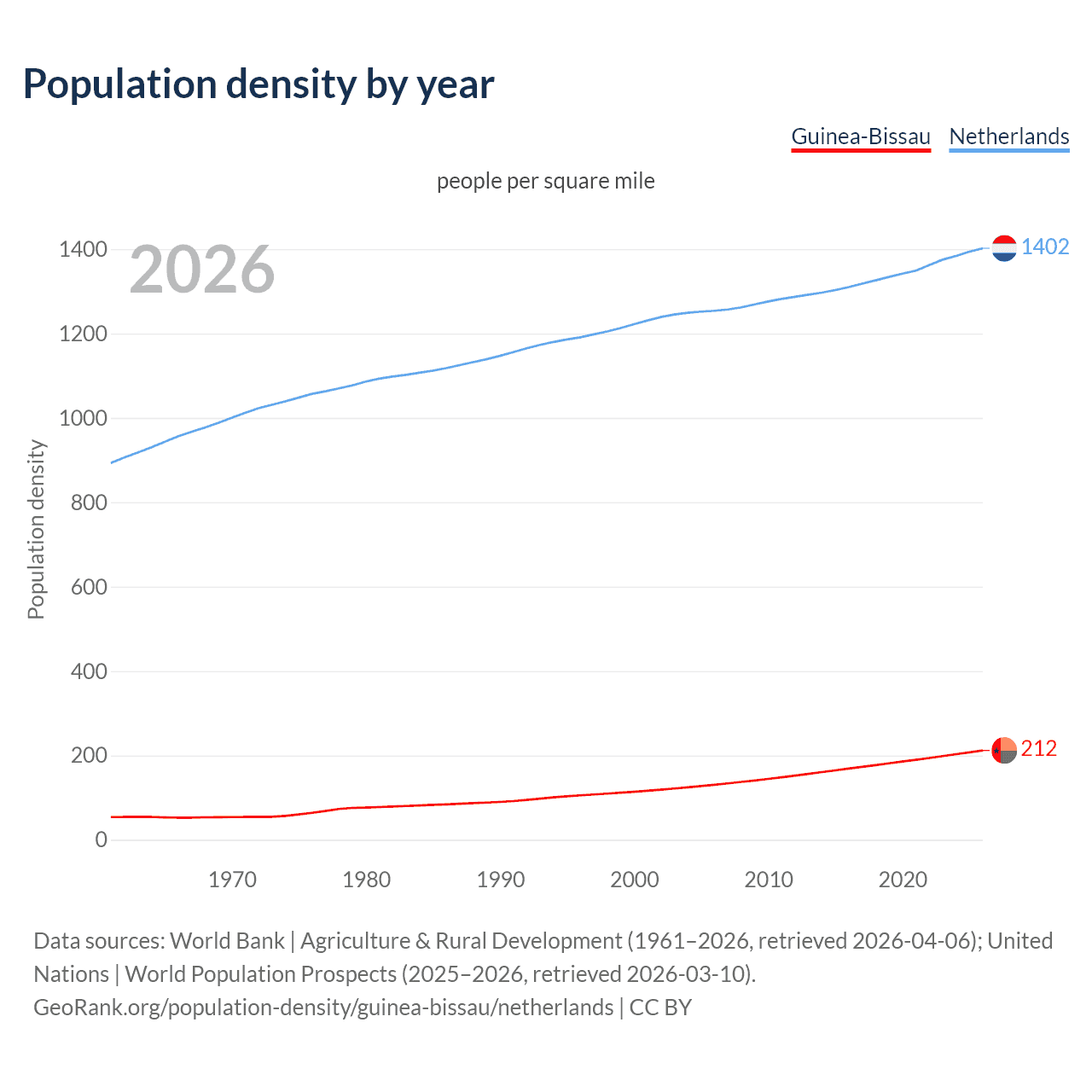
people per square mile
| Year | Population density | |
|---|---|---|
 Guinea-Bissau
|
 Netherlands
|
|
| 2026 | 211.7 | 1,400 |
| 2025 | 207.2 | 1,391 |
| 2024 | 202.8 | 1,384 |
| 2023 | 198.3 | 1,375 |
| 2022 | 193.9 | 1,362 |
| 2021 | 189.6 | 1,349 |
| 2020 | 185.4 | 1,342 |
| 2019 | 181.2 | 1,334 |
| 2018 | 177 | 1,326 |
| 2017 | 172.9 | 1,318 |
| 2016 | 168.7 | 1,310 |
| 2015 | 164.5 | 1,303 |
| 2014 | 160.4 | 1,297 |
| 2013 | 156.2 | 1,292 |
| 2012 | 152.1 | 1,287 |
| 2011 | 148.1 | 1,282 |
| 2010 | 144.3 | 1,276 |
| 2009 | 140.6 | 1,269 |
| 2008 | 137.1 | 1,262 |
| 2007 | 133.6 | 1,257 |
| 2006 | 130.4 | 1,254 |
| 2005 | 127.3 | 1,252 |
| 2004 | 124.3 | 1,249 |
| 2003 | 121.5 | 1,245 |
| 2002 | 118.8 | 1,239 |
| 2001 | 116.2 | 1,231 |
| 2000 | 113.7 | 1,222 |
| 1999 | 111.5 | 1,213 |
| 1998 | 109.4 | 1,205 |
| 1997 | 107.4 | 1,198 |
| 1996 | 105.3 | 1,191 |
| 1995 | 103.2 | 1,186 |
| 1994 | 100.6 | 1,180 |
| 1993 | 97.5 | 1,173 |
| 1992 | 94.3 | 1,165 |
| 1991 | 91.6 | 1,156 |
| 1990 | 89.7 | 1,147 |
| 1989 | 88.2 | 1,139 |
| 1988 | 86.8 | 1,132 |
| 1987 | 85.4 | 1,125 |
| 1986 | 84 | 1,118 |
| 1985 | 82.7 | 1,112 |
| 1984 | 81.4 | 1,107 |
| 1983 | 80.1 | 1,102 |
| 1982 | 78.8 | 1,098 |
| 1981 | 77.6 | 1,093 |
| 1980 | 76.4 | 1,086 |
| 1979 | 75.5 | 1,077 |
| 1978 | 72.9 | 1,070 |
| 1977 | 68.3 | 1,063 |
| 1976 | 63.9 | 1,057 |
| 1975 | 60 | 1,048 |
| 1974 | 56.5 | 1,039 |
| 1973 | 54.6 | 1,031 |
| 1972 | 54 | 1,023 |
| 1971 | 54 | 1,012 |
| 1970 | 53.8 | 1,000 |
| 1969 | 53.6 | 988 |
| 1968 | 53.3 | 977 |
| 1967 | 52.4 | 967 |
| 1966 | 52.2 | 956 |
| 1965 | 53 | 943 |
| 1964 | 54.2 | 930 |
| 1963 | 54.7 | 918 |
| 1962 | 54.3 | 906 |
| 1961 | 53.7 | 893 |
Data sources: World Bank | Agriculture & Rural Development (1961–2026, retrieved 2026-07-08); United Nations | World Population Prospects (2026, retrieved 2026-07-08).
GeoRank.org/population-density/guinea-bissau/netherlands | CC BY 
From 2006 to 2026, population density in Guinea-Bissau increased by 62.4%, compared to a 11.6% growth in the Netherlands.
In 2006, Guinea-Bissau ranked 124th by population density and is 108th now. The Netherlands was 15th in 2006 and ranks 17th out of 197 currently.
Population density comparison
|
Guinea-Bissau
|
Netherlands
|
|
|---|---|---|
| Population density | 211.7 ppl/mi² | 1,400 ppl/mi² |
| Population density rank | 108/197 | 17/197 |
| Population |
2323460
|
18243998
|
| Land area | 10,857 sq mi | 13,000 sq mi |
| Land area per capita | 134,554 sq ft | 20,037 sq ft |
| Rural population | 53.3% | 4.06% |
| Urban population | 46.7% | 95.9% |
| Living in agglomerations of 1M+ people | 0% | 0% |
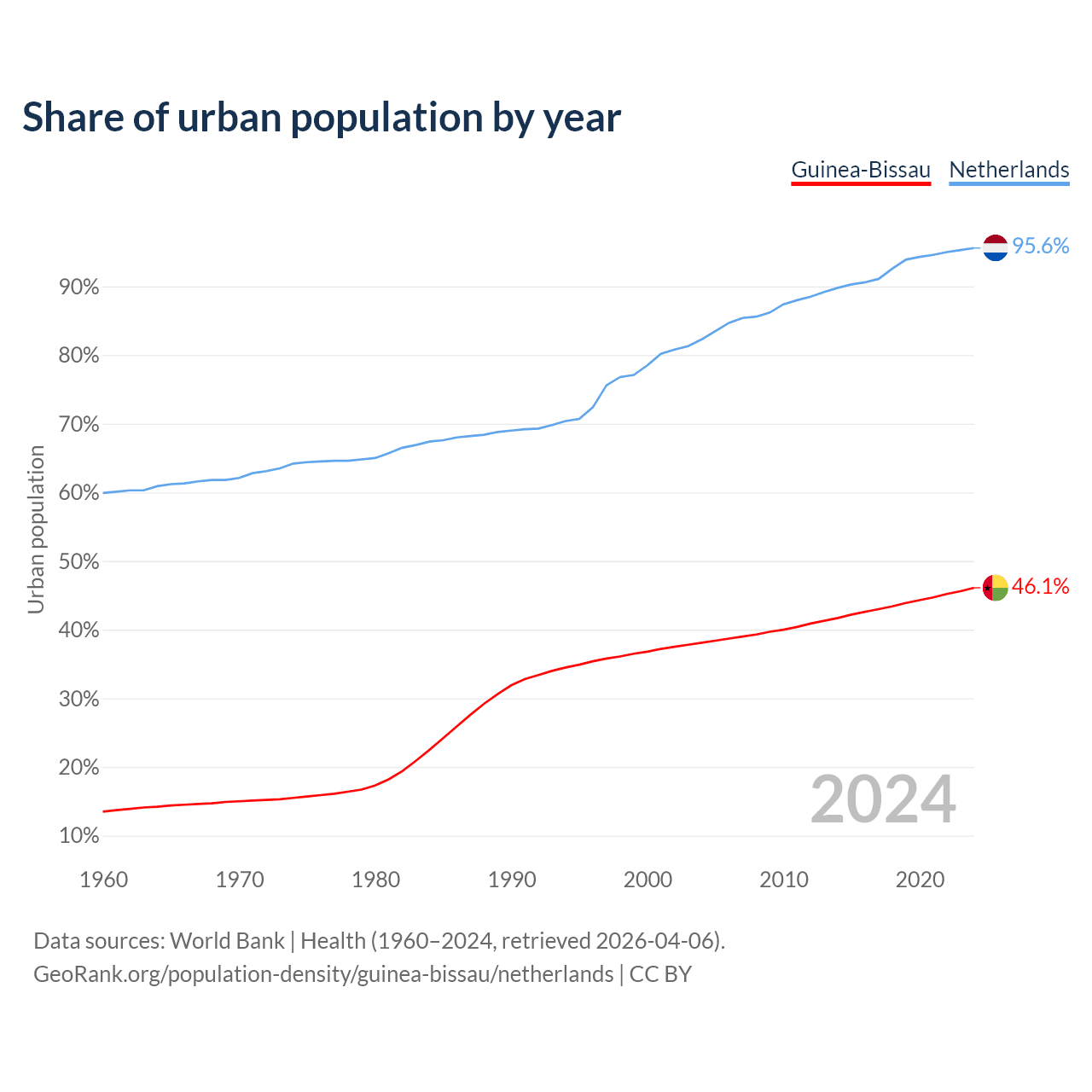
Share of urban population by year
| Year | Urban population | |
|---|---|---|
|
Guinea-Bissau
|
Netherlands
|
|
| 2025 | 46.7% | 95.9% |
| 2024 | 46.1% | 95.6% |
| 2023 | 45.6% | 95.3% |
| 2022 | 45.2% | 95% |
| 2021 | 44.7% | 94.6% |
| 2020 | 44.3% | 94.3% |
| 2019 | 43.9% | 93.9% |
| 2018 | 43.4% | 92.6% |
| 2017 | 43% | 91.1% |
| 2016 | 42.6% | 90.6% |
| 2015 | 42.2% | 90.3% |
| 2014 | 41.7% | 89.8% |
| 2013 | 41.3% | 89.2% |
| 2012 | 40.9% | 88.5% |
| 2011 | 40.4% | 88% |
| 2010 | 40% | 87.4% |
| 2009 | 39.7% | 86.2% |
| 2008 | 39.3% | 85.6% |
| 2007 | 39% | 85.4% |
| 2006 | 38.7% | 84.7% |
| 2005 | 38.4% | 83.5% |
| 2004 | 38.1% | 82.3% |
| 2003 | 37.8% | 81.3% |
| 2002 | 37.5% | 80.8% |
| 2001 | 37.2% | 80.2% |
| 2000 | 36.8% | 78.5% |
| 1999 | 36.5% | 77.1% |
| 1998 | 36.1% | 76.8% |
| 1997 | 35.8% | 75.6% |
| 1996 | 35.4% | 72.4% |
| 1995 | 34.9% | 70.7% |
| 1994 | 34.5% | 70.4% |
| 1993 | 34% | 69.8% |
| 1992 | 33.4% | 69.3% |
| 1991 | 32.8% | 69.2% |
| 1990 | 31.9% | 69% |
| 1989 | 30.6% | 68.8% |
| 1988 | 29.2% | 68.4% |
| 1987 | 27.6% | 68.2% |
| 1986 | 25.9% | 68% |
| 1985 | 24.2% | 67.6% |
| 1984 | 22.5% | 67.4% |
| 1983 | 20.9% | 66.9% |
| 1982 | 19.4% | 66.5% |
| 1981 | 18.2% | 65.7% |
| 1980 | 17.3% | 65% |
| 1979 | 16.7% | 64.8% |
| 1978 | 16.4% | 64.6% |
| 1977 | 16.1% | 64.6% |
| 1976 | 15.9% | 64.5% |
| 1975 | 15.7% | 64.4% |
| 1974 | 15.5% | 64.2% |
| 1973 | 15.3% | 63.5% |
| 1972 | 15.2% | 63.1% |
| 1971 | 15.1% | 62.8% |
| 1970 | 15% | 62.1% |
| 1969 | 14.9% | 61.8% |
| 1968 | 14.7% | 61.8% |
| 1967 | 14.6% | 61.6% |
| 1966 | 14.5% | 61.3% |
| 1965 | 14.4% | 61.2% |
| 1964 | 14.2% | 60.9% |
| 1963 | 14.1% | 60.3% |
| 1962 | 13.9% | 60.3% |
| 1961 | 13.7% | 60.1% |
| 1960 | 13.5% | 59.9% |
Data sources: World Bank | Health (1960–2025, retrieved 2026-07-08).
GeoRank.org/population-density/guinea-bissau/netherlands | CC BY
From 2005 to 2025, the share of urban population changed from 38.4% to 46.7% in Guinea-Bissau and from 83.5% to 95.9% in the Netherlands.
Densely populated cities
|
Netherlands
|
|
|---|---|
| City | Population |
| Amsterdam | 921K |
| Rotterdam | 664K |
| The Hague | 548K |
| Utrecht | 359K |
| Eindhoven | 244K |
| Groningen | 238K |
| Tilburg | 228K |
| Almere | 215K |
| Breda | 188K |
| Nijmegen | 177K |
Compare countries by 7 more topics
Population density in other countries

Data sources: World Bank | Agriculture & Rural Development (1961–2026, retrieved 2026-07-08); United Nations | World Population Prospects (1961–2026, retrieved 2026-07-08); U.S. Census Bureau (1961–2025, retrieved 2026-07-08); Central Intelligence Agency (CIA) (2000–2019, retrieved 2026-07-08).
GeoRank.org/population-density/guinea-bissau/netherlands | CC BY
Help us show the world through your eyes
Share a photo of your city and help others discover what it looks like to live there. Your contribution makes our data come alive.
Data sources:
- World Bank | Agriculture & Rural Development (1961–2026, retrieved 2026-07-08)
- United Nations | World Population Prospects (1961–2026, retrieved 2026-07-08)
- U.S. Census Bureau (1961–2025, retrieved 2026-07-08)
- Central Intelligence Agency (CIA) (2000–2019, retrieved 2026-07-08)
- Wikidata (2021–2025, retrieved 2026-07-08)
Creative Commons Attribution (CC BY) — you’re free to copy, share, remix, adapt, and use even commercially as long as you give appropriate credit and clearly indicate if you made changes. Other sources may be subject to different license terms.